
Blog prepared for House for Rent in Niagara — houseforrentinniagara.com | Local Niagara Rental Specialist | May 2026
Niagara Falls is one of Canada’s most visited tourist destinations, attracting over 14 million visitors annually. That level of consistent demand makes the Niagara Region one of Ontario’s most compelling markets for short-term rentals — and one of the most regulated ones too. Before you list your property on Airbnb or VRBO, there is a significant amount a Niagara landlord needs to understand: which zones allow short-term rentals, which licence type applies to you, what taxes you must collect, and what the City is doing right now with its pilot project that is reshaping residential hosting rules.
This guide gives you the complete, up-to-date picture for 2026 — rules, profits, and practical tips to help you host legally and profitably in the Niagara Region.
Who Is This Guide For?
- Niagara Falls homeowners wondering if they can legally list their home or secondary suite on Airbnb
- Landlords and investors evaluating whether a Niagara property is worth buying for short-term rental income
- Existing short-term rental operators who want to ensure they are fully compliant with 2025–2026 updated regulations
- Anyone comparing long-term vs. short-term rental income potential in the Niagara market
What Is the Difference Between a VRU and an OOSTR in Niagara Falls?
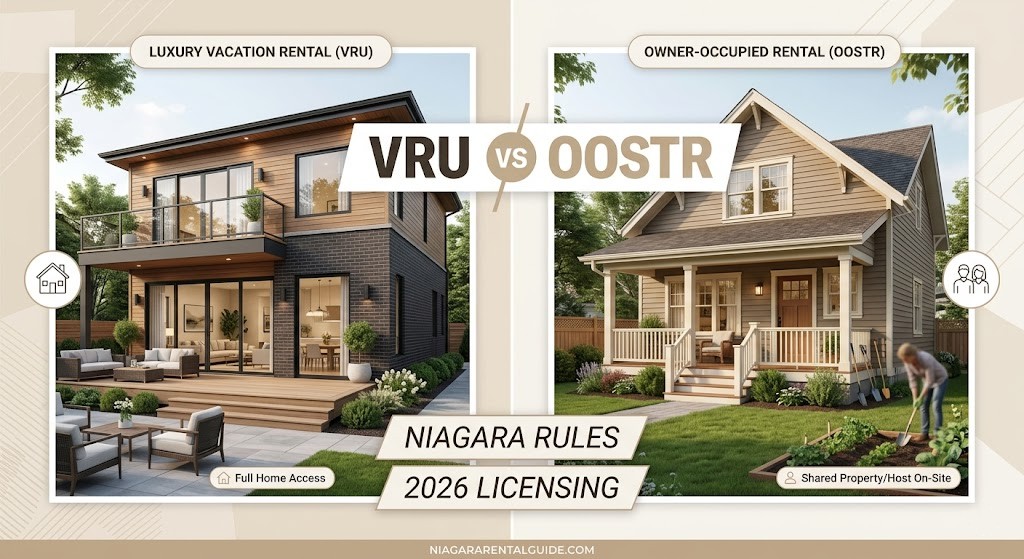
This is the most important distinction every Niagara landlord needs to understand — and the one that most creates confusion.
The City of Niagara Falls operates two separate categories of short-term rental:
| Type | What It Is | Where It’s Allowed | Owner Required On-Site? | Key Requirement |
|---|---|---|---|---|
| Vacation Rental Unit (VRU) | Entire property rented to one group (no owner present) — traditional Airbnb whole-home listing | Tourist Commercial (TC), General Commercial (GC), and Central Business (CB) zones ONLY — NOT residential zones | No | Annual City licence ($500); must be in permitted commercial zone |
| Owner Occupied Short-Term Rental (OOSTR) | Dwelling unit within or accessory to the owner’s principal residence, rented while owner is present on site | Residential zones — part of a 14-month pilot project (August 2025 – September 2026) | Yes — owner must be present during all rentals | Application accepted for pilot (max 100 licences); annual licence required |
The practical implication is significant: if you do not live at the property, you cannot operate a short-term rental in a residential zone in Niagara Falls. Whole-home Airbnb listings in residential neighbourhoods are only legal in permitted commercial zones as a VRU — or through the limited OOSTR pilot if the owner is present.
What Are the Current Rules for Short-Term Rentals in Niagara Falls? (2026)
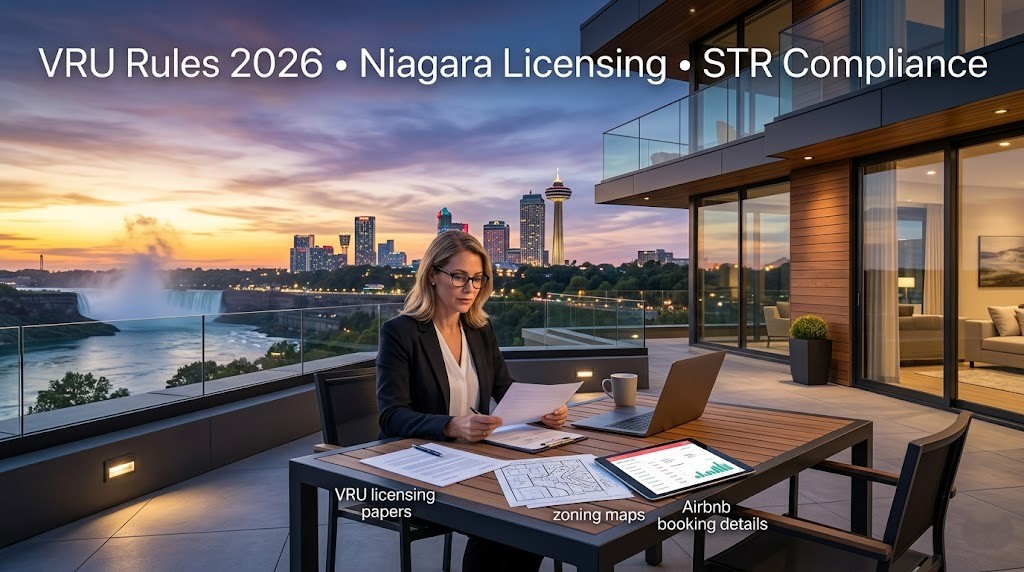
Vacation Rental Units (VRUs) — Full Property Rentals
For landlords operating in commercial zones, the City of Niagara Falls has an established licensing framework:
- Licence required: Annual City of Niagara Falls VRU licence — fee of $500
- Permitted zones: Tourist Commercial (TC), General Commercial (GC), Central Business (CB) — residential zones are NOT permitted for VRUs
- Maximum stay: 28 consecutive days or less per booking
- MAT (Municipal Accommodation Tax): 4% collected on every booking and remitted to the City
- Enforcement: Three-strike system — violations can result in licence suspension or revocation
- Platforms such as Airbnb and VRBO are advertising platforms only — they do not grant you permission to operate. Your City licence is the legal authority.
Owner Occupied Short-Term Rentals (OOSTRs) — The 2025–2026 Pilot
The City of Niagara Falls launched a 14-month pilot project in August 2025 to explore allowing owner-occupied short-term rentals in residential areas. Key facts for 2026:
- Pilot window: August 2025 – September 2026
- Maximum licences issued: 100 across the entire city
- Owner presence required: The owner must be on-site and present during all rentals — absentee hosting is not permitted
- Maximum stay: 28 consecutive days per booking
- Additional parking: Must be available on the property
- Licensing: Annual City of Niagara Falls licence required
- Application: Apply at niagarafalls.ca/oostr — submission does not guarantee acceptance
- Post-pilot decision: City Council will assess the program in September 2026 and decide whether to continue, expand, or end it
This pilot has been described as a significant shift, as the previous rules essentially eliminated residential Airbnb in Niagara Falls. However, with only 100 licences available and the owner-present requirement, it remains a limited and tightly controlled programme.
What Are the Short-Term Rental Rules in Niagara-on-the-Lake?
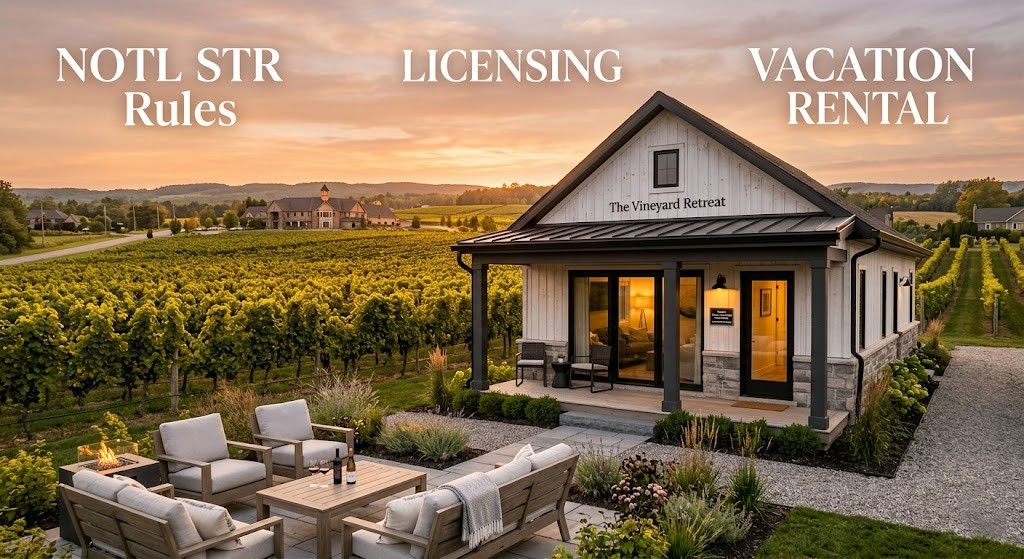
Niagara-on-the-Lake (NOTL) has its own, more established licensing framework that applies separately from the City of Niagara Falls:
- Licence required: Annual STR licence — $800 for new applications; $600 for renewals
- Renewal deadline: Licences expiring December 31, 2026, must be renewed before that date or be considered invalid — a new application and full fee would then apply
- Types of licensed establishments: Bed and Breakfast, Cottage Rental, Country Inn, Vacation Apartment, Villa
- Electrical Safety Certificate: Required for all new and renewal applications every four years (ESA inspection certificate or licensed electrical contractor letter)
- Insurance: Valid certificate of insurance required at application and maintained annually while licensed
- Fuel-burning appliances: Proof of inspection within the last year required
- Process time: Up to 10 weeks from complete application submission to licence issuance — plan well ahead of your operating season
- Licence not transferable: If you sell the property, the new owner must apply separately
MAT tax also applies in NOTL. If you operate a licensed STR in Niagara-on-the-Lake, you must collect and remit the Municipal Accommodation Tax on all bookings.
For most landlords, the management fee is the visible cost of professional property management. The hidden savings — in avoided vacancies, avoided bad tenancy costs, avoided legal errors, and time — typically exceed the fee significantly over a 12-month period.
St. Catharines operates a separate short-term rental licensing regime:
- Licence required: City of St. Catharines short-term rental licence — issued for a 2-year period
- Application fee required before licence issuance
- The property must comply with applicable zoning, fire code, and safety requirements
The detailed regulatory framework in St. Catharines continues to evolve — landlords operating in St. Catharines should verify current requirements directly with the City before listing.
Is There a Province-Wide Airbnb Law in Ontario?
There is no single province-wide law governing short-term rentals in Ontario. Each municipality sets its own rules under powers granted by the province. This means the rules in Niagara Falls, Niagara-on-the-Lake, St. Catharines, and Hamilton are all different — and can change independently of each other.
What does apply province-wide is Ontario income tax rules: short-term rental income is reportable as business or rental income on your federal and provincial tax returns. Hosts should maintain detailed records of all rental income, platform fees paid, and operating expenses for tax purposes.
How Profitable Is Airbnb in Niagara Falls?
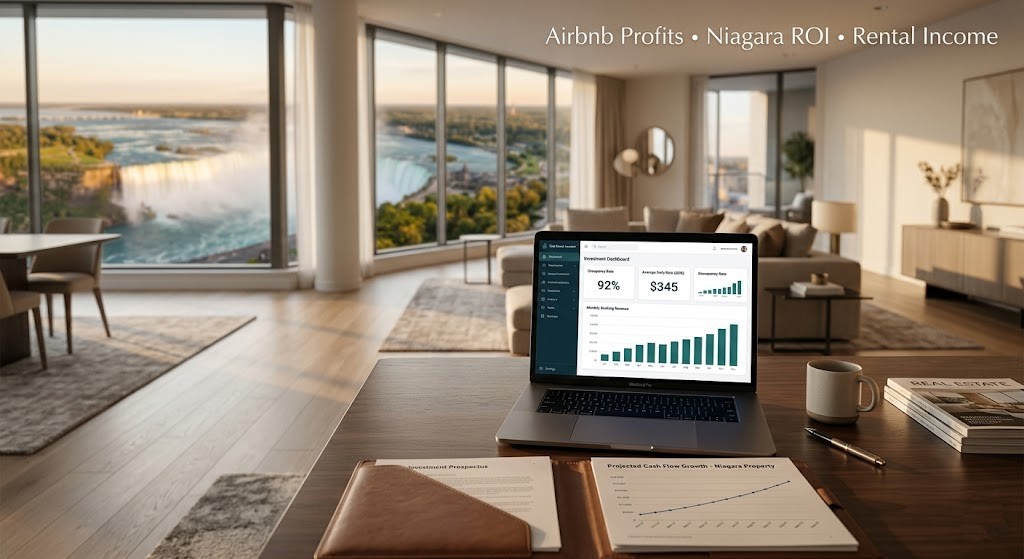
Niagara Falls has a genuine advantage over most Ontario markets: a tourism-driven economy that fills hotels and short-term rentals year-round, not just in summer. Here is what the data shows for Niagara Falls STR performance:
| Metric | Niagara Falls (ON) Market Data |
|---|---|
| Typical occupancy rate | 56–62% |
| Average daily rate (ADR) | ~$113–$155 CAD per night |
| Annual projected revenue | ~$25,000–$35,000 CAD per property |
| Best-performing months | June, July, August, October (fall foliage + wine harvest season) |
| Peak demand drivers | Niagara Falls tourism, winery season, Blossom Festival, New Year’s events, casino visitors |
| Compared to long-term rental | STR monthly cash flow is typically 1.5–2x comparable long-term rental income in tourist zones |
What Taxes Does a Niagara Short-Term Rental Host Pay?
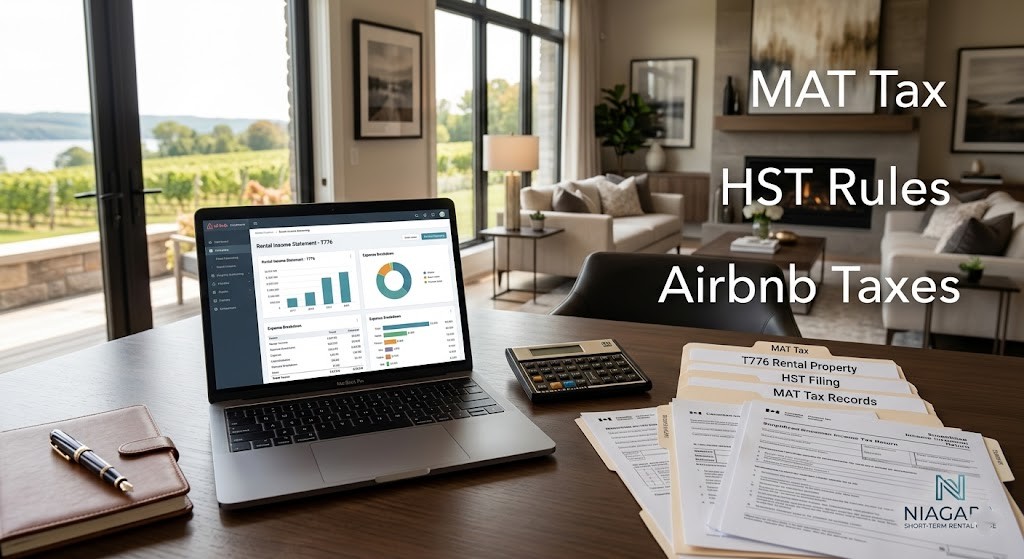
Short-term rental income in Niagara comes with tax obligations at multiple levels:
| Tax | Rate | Who Collects | Who Remits |
|---|---|---|---|
| Municipal Accommodation Tax (MAT) | 4% of accommodation cost | Host (via booking platforms where integrated) | Host remits to City of Niagara Falls or NOTL quarterly |
| Federal Income Tax (CRA) | Personal tax rate on net rental/business income | N/A | Host reports on T1 tax return |
| Ontario Provincial Income Tax | Personal rate on net income | N/A | Host reports on T1 tax return |
| HST (if applicable) | 13% — applies if gross revenue exceeds $30,000 over 4 consecutive calendar quarters | Host | Host must register for HST and remit |
Important: If your Airbnb revenue exceeds $30,000 in four consecutive calendar quarters, you are required to register for and collect HST from guests. Many Niagara hosts do not realise this threshold applies to them until they are already over it. Consult a tax professional at the outset.
Airbnb does collect and remit the MAT on behalf of hosts in Niagara Falls where the integration is in place — but it is your responsibility as a host to verify this is occurring correctly and to understand your own obligations.
8 Practical Tips for Niagara Landlords Considering Short-Term Rental
- Verify your zone before you list. The single most common compliance error in Niagara Falls is listing in a residential zone without the owner-present OOSTR licence. Check your property’s zoning at niagarafalls.ca before doing anything else. If your property is in TC, GC, or CB zones, a VRU licence is your path. If residential, the OOSTR pilot applies — but only 100 licences are available city-wide.
- Get licensed before you list — not after. Operating without a licence exposes you to fines and the City’s three-strike enforcement system. In Niagara Falls, penalties include licence suspension and revocation. In NOTL, operating without a licence is a bylaw offence. Your licence number must be displayed on your listing on all platforms.
- Price seasonally — Niagara is not a flat-rate market. June through October is high season in Niagara wine country. New Year’s Eve, the WFOL Festival of Lights (November–January), and the Cherry Blossom Festival (April–May) all represent demand spikes. Use a dynamic pricing tool (PriceLabs, Wheelhouse, or Airbnb’s own Smart Pricing) to ensure your rates respond to demand — not a fixed nightly rate that leaves money on the table in July and undervalues your property in December.
- Invest in professional photography. In a market as photo-driven as Niagara — where guests compare dozens of listings — professional photos are not optional. Listings with professional photography earn demonstrably more per booking and achieve higher occupancy rates. Budget $200–$400 for professional short-term rental photography before your first listing goes live.
- Make outdoor space a selling point. Niagara’s wine country, falls, and natural landscapes draw guests who want to experience them — not just sleep near them. Properties with patios, decks, fire pits, or outdoor dining spaces significantly outperform comparable properties without them. If your property has outdoor space, invest in it and feature it prominently.
- Respond to every review — good and bad. Your Airbnb Superhost status and search ranking depend heavily on your review score and responsiveness rate. Respond to every guest review — thank positive reviewers genuinely, and address negative reviews professionally and constructively. Future guests read host responses as carefully as they read reviews.
- Understand the long-term vs short-term calculation honestly. Short-term rental income in Niagara can be significantly higher than long-term rental income — but it comes with higher operating costs: platform fees (3–5% host fee), cleaning costs per turnover, restocking supplies, higher insurance, and more hands-on management. Model your net income honestly before committing. A property earning $35,000 gross from Airbnb with $12,000 in operating costs and $3,000 in taxes nets $20,000 — comparable to many long-term leases, but with more work.
8. Consider a local property manager if you are not on-site. For VRU operators in commercial zones where owner presence is not required, professional short-term rental property managers in Niagara handle guest communications, cleaning coordination, key management, and compliance tracking — typically for 15–25% of revenue. For out-of-town investors, this is often the difference between a functional STR business and a liability.
Long-Term vs Short-Term Rental: Which Is Right for Your Niagara Property?
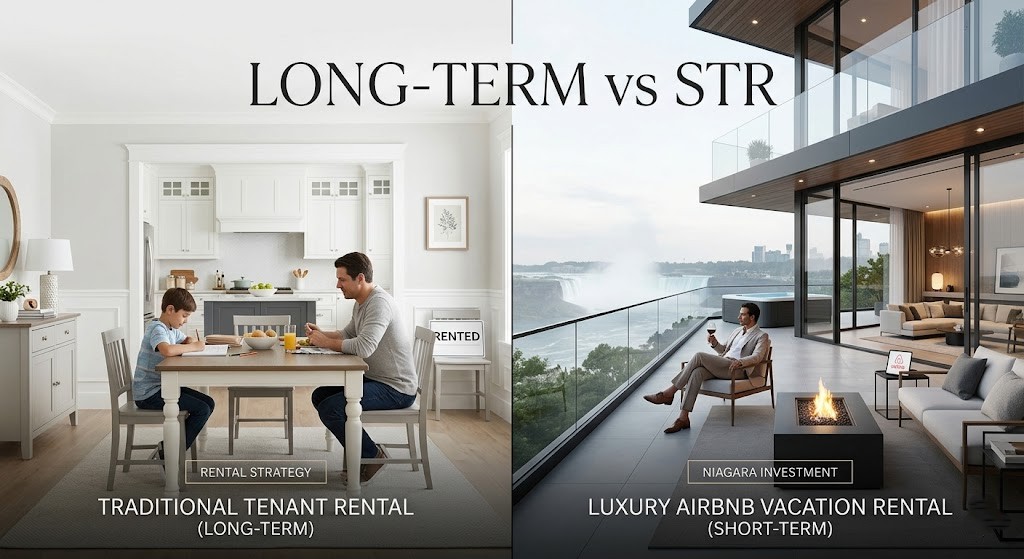
| Factor | Long-Term Rental | Short-Term Rental (Airbnb/VRBO) |
|---|---|---|
| Income potential | Stable, predictable monthly income | Higher ceiling, but seasonal variance |
| Operating costs | Lower — tenant covers utilities, fewer turnovers | Higher — cleaning, supplies, platform fees |
| Management time | Lower — fewer interactions | Higher — guest communications, turnovers |
| Vacancy risk | Low — stable tenants | Seasonal — lower demand Nov–March |
| Regulatory complexity | Governed by Ontario Residential Tenancies Act | City licence, zoning rules, MAT tax |
| Tenant protections | Strong (RTA) — eviction is regulated | Guests have limited protections vs. tenants |
| Best for | Investors wanting passive, stable income | Owner-occupiers, commercially zoned properties, active operators |
| Best Niagara zones | Anywhere residential | TC/GC/CB zones (VRU) or OOSTR pilot in residential |
How a Local Niagara Realtor Can Help
Navigating the zoning rules, licensing process, and investment analysis for short-term rental in Niagara is complex — and the stakes of getting it wrong are real. A local Niagara realtor with experience in the rental market can:
- Confirm the zoning designation of any property you are considering for short-term rental use before you purchase
- Advise on which neighbourhoods and property types perform best on Airbnb in the current Niagara market
- Help you understand the impact of the OOSTR pilot on residential properties you already own
- Connect you with the right professionals — licensing consultants, property managers, insurance brokers — to launch a compliant short-term rental operation
- Compare the net return on short-term vs. long-term rental for your specific property, location, and circumstances
Ready to explore your options? Contact me at houseforrentinniagara.com for a free rental strategy consultation tailored to your Niagara property.
Frequently Asked Questions
Is Airbnb legal in Niagara Falls, Ontario in 2026?
Yes — but with significant restrictions depending on your property type and zone. Entire-home (non-owner-present) short-term rentals, called Vacation Rental Units (VRUs), are only permitted in Tourist Commercial, General Commercial, and Central Business zones — not in residential areas. In residential zones, the City launched a 14-month OOSTR pilot (August 2025–September 2026) allowing owner-occupied short-term rentals where the owner is present
What is the Municipal Accommodation Tax (MAT) and do I have to collect it?
The Municipal Accommodation Tax (MAT) is a 4% tax levied on all short-term accommodation bookings in Niagara Falls. As a licensed short-term rental operator, you are required to collect and remit this tax on every booking. Airbnb in many cases collects and remits MAT directly on behalf of hosts in Niagara — but it is your responsibility to confirm this is happening and to understand your own remittance obligations. Failure to collect or remit MAT is a compliance violation.
How much does a short-term rental licence cost in Niagara Falls?
The City of Niagara Falls charges a $500 annual licence fee for Vacation Rental Units (VRUs) in commercial zones. The OOSTR pilot licence fee should be confirmed directly with the City at businesslicensing@niagarafalls.ca or 905-356-7521. In Niagara-on-the-Lake, new STR licence applications cost $800 and renewals cost $600. These fees are in addition to the compliance costs of meeting inspection, insurance, and safety requirements.
Can I run an Airbnb in a residential area in Niagara Falls?
Only under the OOSTR pilot project (August 2025–September 2026), and only if you are the full-time owner-occupant of the property and are present on-site during all rentals. The pilot is capped at 100 licences city-wide. Submitting an application does not guarantee acceptance. If the pilot concludes in September 2026, its continuation depends on City Council’s assessment. Whole-home Airbnb rentals (owner absent) in residential zones remain prohibited.
How profitable is short-term rental in Niagara Falls compared to long-term rental?
In permitted zones with a licensed VRU, short-term rental income in Niagara Falls can generate $25,000–$35,000 CAD annually at 56–62% occupancy with an average daily rate of $113–$155. This typically represents 1.5–2x the income of a comparable long-term rental — but operating costs (cleaning, supplies, platform fees, insurance) are significantly higher. Net income after expenses needs to be modelled carefully per property. Properties in Tourist Commercial zones closest to the falls and major attractions perform best.
Is rent-to-own a good idea in the Niagara housing market in 2026?
In 2026, Niagara’s buyer-leaning market with a benchmark price of $573,900 and longer days on market means sellers may be more open to rent-to-own arrangements. Locking in a price now could be advantageous if prices recover during your term — but if prices fall further, you could be buying above market. Legal and financial advice before signing is essential.
Do I need to register for HST on my short-term rental income?
If your gross short-term rental revenue exceeds $30,000 in four consecutive calendar quarters, you are required to register for HST with the CRA, collect 13% HST on bookings, and remit it to the government. Many part-time Niagara hosts underestimate how quickly this threshold can be reached during peak season. Consult a tax professional before launching to understand your obligations and set up your bookkeeping correctly from the start.
What happens if a tenant stops paying rent in Ontario?
If a tenant falls into rent arrears, the landlord must serve a Form N4 (Notice to End Tenancy for Non-Payment of Rent), giving the tenant 14 days to pay or vacate. If unresolved, the landlord can file an L1 application with the Landlord and Tenant Board. The process requires correct documentation and timing — errors can delay resolution by months.
What happens if I operate a short-term rental without a licence in Niagara Falls?
Operating without a licence in Niagara Falls is subject to enforcement under the City’s three-strike system for short-term rentals. Violations can result in fines, licence suspension, or permanent revocation. In Niagara-on-the-Lake, operating without a licence is a bylaw offence. Platforms like Airbnb also increasingly require hosts to display their licence number on their listing — unlicensed listings may be flagged or removed by the platform.
Can I buy a property in Niagara specifically for short-term rental investment?
Yes — but the zone is everything. A property in a Tourist Commercial zone in Niagara Falls can legally operate as a VRU (entire-home rental, owner not present). A residential property does not have the same legal pathway for absentee short-term rental. Before purchasing any property in Niagara for STR purposes, confirming the zoning designation is critical — your investment analysis depends entirely on what the City permits at that address. A local Niagara realtor can confirm zoning and advise on the best areas for STR investment before you make an offer.
What is the OOSTR pilot and what happens when it ends in September 2026?
The Owner Occupied Short-Term Rental (OOSTR) pilot is a 14-month City of Niagara Falls programme allowing owner-present short-term rentals in residential areas, limited to 100 licences, running from August 2025 to September 2026. At the end of the pilot, City Council will assess its success and decide whether to continue, modify, or discontinue the programme. Hosts operating under OOSTR pilot licences should monitor the City’s communications closely as the September 2026 decision point approaches, as continuation is not guaranteed.
Should I hire a property manager for my Niagara short-term rental?
For VRU operators in commercial zones (where you are not required to be on-site), a local STR property manager typically charges 15–25% of gross revenue to handle guest communications, check-in coordination, cleaning management, and compliance tracking. For out-of-town investors or landlords who do not want to manage guest communications personally, the cost is generally worthwhile — particularly during Niagara’s high-season months when demand, turnover, and guest interactions are highest. For OOSTR operators, you must be present on-site in any case, which limits the role of a traditional property manager.

Arzman Singh
Arzman is a Niagara-based realtor with over 6 years of experience, working with Quantum Team Realty Team. He specializes in helping clients find rental or lease properties, offering expert guidance in the Niagara real estate market.