
Blog prepared for HouseForRentInNiagara.com | Niagara Region Rental Listings & Realtor Services | May 2026
If you own a rental property in the Niagara Region — in St. Catharines, Niagara Falls, Welland, Fort Erie, Grimsby, or anywhere across the region — you are operating under one of the most comprehensive pieces of residential tenancy legislation in Canada.
The Ontario Residential Tenancies Act (RTA) governs virtually every aspect of your relationship with your tenant: how you select them, what your lease must say, how much you can charge and when you can raise it, when you can enter the property, what happens if rent is not paid, and under what circumstances a tenancy can end.
In 2025 and 2026, the RTA has seen its most significant amendments in years. Bill 60 — the Fighting Delays, Building Faster Act, 2025 — received Royal Assent on November 27, 2025, and is being brought into force in stages through 2026. Bill 97 — Helping Homebuyers, Protecting Tenants Act, 2023 — also has new provisions taking effect July 1, 2026 and September 21, 2026.
If you have not reviewed your practices since these changes passed, this guide is your starting point.
What Is the Ontario Residential Tenancies Act?

What Does the Ontario RTA Cover and Who Does It Apply To?
The Residential Tenancies Act, 2006 (RTA) is Ontario’s primary legislation governing residential rental relationships. It applies to virtually all private residential tenancies in Ontario — including houses, apartments, basement units, condominiums, and secondary suites.
Its stated purposes are to:
- Protect residential tenants from unlawful rent increases and unlawful evictions
- Establish a framework for the regulation of residential rents
- Balance the rights and responsibilities of landlords and tenants
- Provide for dispute adjudication through the Landlord and Tenant Board (LTB)
The RTA applies to you as a Niagara landlord regardless of whether your tenant is a friend, family acquaintance, or stranger. The Act does not distinguish based on the nature of the relationship — it applies to all residential tenancies in Ontario. There are very limited exemptions (such as shared bathroom/kitchen arrangements in the landlord’s own primary residence), but the vast majority of Niagara rental situations are fully covered.
The Ontario Standard Lease — Still Mandatory

Do I Have to Use the Ontario Standard Lease?
Yes — and this remains one of the most commonly violated requirements among private Niagara landlords.
Since April 30, 2018, all new residential tenancy agreements in Ontario must use the Ontario Standard Lease — a government-mandated form. You cannot use your own template, a downloaded form from the internet, or a lease prepared without reference to the Standard Lease requirements.
What happens if you do not use the Standard Lease?
- A tenant can request the Standard Lease in writing at any time
- If you fail to provide it within 21 days, the tenant is legally entitled to withhold one month’s rent
- You cannot evict a tenant for withholding rent in this specific circumstance until the Standard Lease is provided
The Standard Lease allows landlords to add additional terms in a designated section — but those additional terms cannot contradict or waive any rights under the RTA. Common additional terms that are unenforceable under the RTA include:
- “No pets” clauses (generally unenforceable except in some condominiums)
- Lease termination conditions outside the RTA framework
- Requirements to provide post-dated cheques (prohibited since 2010)
- Clauses waiving the tenant’s right to 24-hour notice before entry
- Rent increases outside the annual guideline structure
Download the current Ontario Standard Lease at: ontario.ca/page/renting-ontario-your-rights
Rent — What You Can Charge and When You Can Increase It
Rent Control — Which Units Does It Apply To?
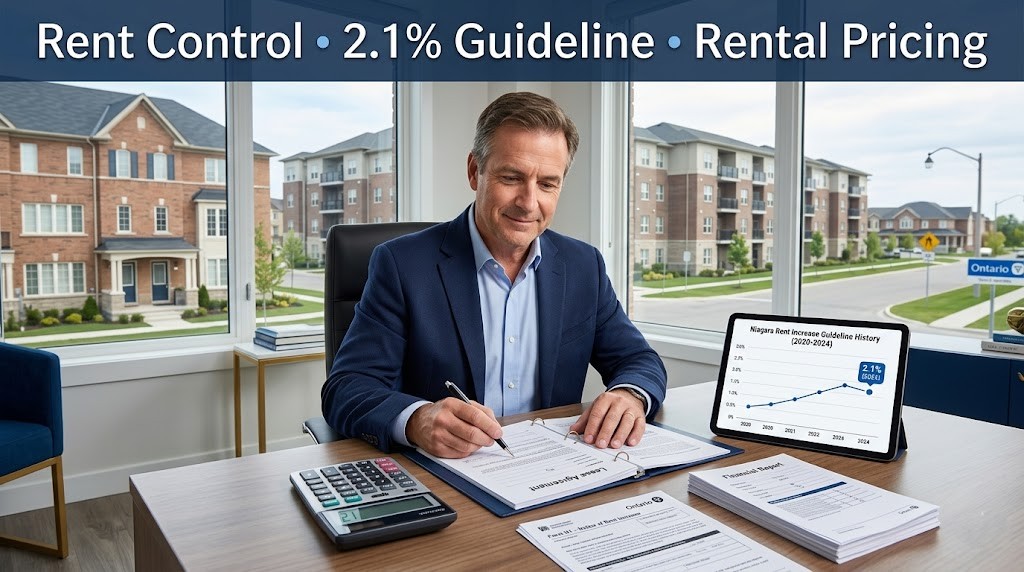
Ontario’s rent control framework applies to most rental units first occupied for residential purposes before November 15, 2018. For these units, rent increases are capped at the provincial annual guideline.
Units first occupied on or after November 15, 2018 are exempt from rent control — landlords of these newer units can increase rent by any amount, subject to the 90-day notice requirement.
The 2026 Rent Increase Guideline is 2.1%.
This is the maximum annual rent increase permitted for rent-controlled units in 2026, as set by the Province of Ontario.
Rent Increase Rules — The Basics
| Rule | Requirement |
|---|---|
| Frequency | Maximum one rent increase per 12-month period |
| Notice Required | 90 days written notice before the increase takes effect |
| Form to Use | Form N1 — Notice of Rent Increase |
| Above-Guideline Increases | Allowed only with LTB approval (Form L5) for specific qualifying capital expenditure or operating cost reasons |
| Vacant Unit Re-rental | No restriction on the rent set for a new tenancy — market rate applies |
| Illegal Rent Increases | Tenant can file with LTB to recover over-payment; landlord faces penalties |
Landlord Entry — Your Rights and Obligations
Why Is a Realtor's Marketing Better Than a Kijiji or Facebook Listing?
When Can a Landlord Enter a Rental Unit in Ontario?
This is one of the most misunderstood areas of the RTA — and one that generates significant LTB complaints
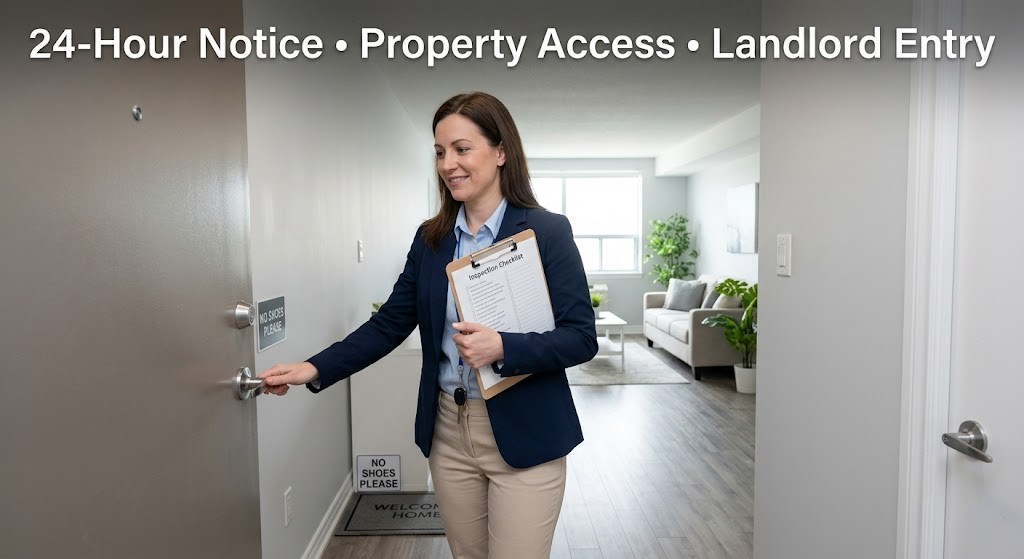
The baseline rule: A landlord must give the tenant at least 24 hours written notice before entering a rental unit, and entry can only occur between 8 a.m. and 8 p.m.
Permitted reasons for entry with 24-hour notice:
- To carry out repairs or maintenance
- For inspection where there are reasonable grounds to believe maintenance is needed
- To show the unit to prospective tenants (when the tenant has given notice to vacate, or the tenancy is being terminated)
- To show the unit to prospective purchasers (with the appropriate notice)
- For agreed-upon inspection
Entry without notice is permitted only in two situations:
- Emergency — fire, flood, or other urgent situation requiring immediate entry
- Tenant consent given at time of entry — tenant agrees to the entry at that specific moment
Entry never permitted:
- Simply because you own the property
- To check up on the tenant
- For reasons not permitted by the RTA
Common landlord mistake: Texting or calling the tenant the day before to say you’ll be coming counts as notice in form only — the RTA requires written notice. A text message may qualify if it creates a written record, but verbal notice does not meet the RTA standard.
Evictions — Forms, Timelines, and 2026 Changes
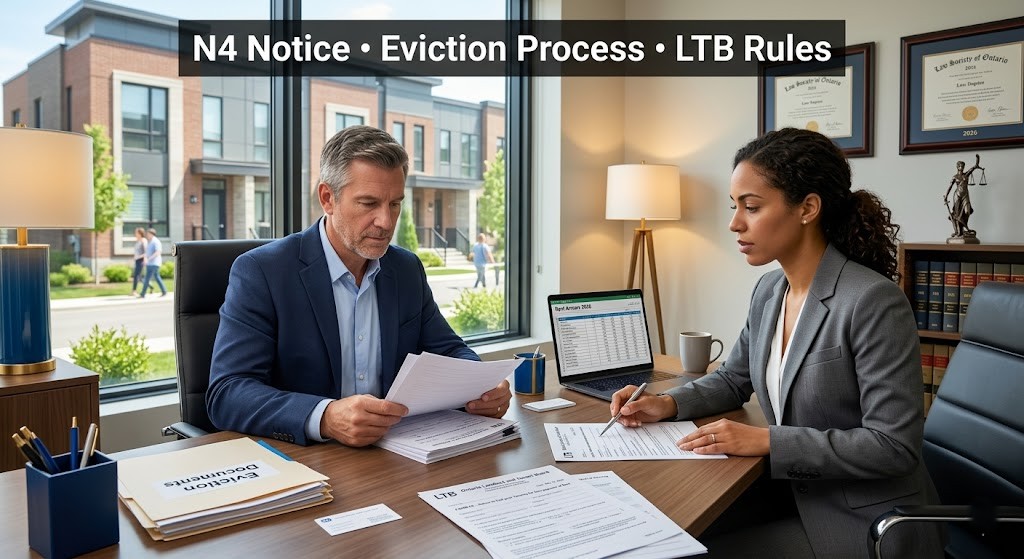
Eviction in Ontario is a multi-step legal process. Landlords cannot change locks, remove belongings, or take any other self-help measure to remove a tenant. Every eviction must go through the LTB.
Non-Payment of Rent — N4 Notice (Key Bill 60 Change)
The most common eviction pathway for Ontario landlords is non-payment of rent.
Process:
- Serve the tenant an N4 — Notice to End a Tenancy Early for Non-payment of Rent
- The N4 gives the tenant a voiding period to pay all rent owed and stop the eviction
Bill 60 Change — effective September 21, 2026: Under the current rules (before Bill 60 takes full effect), the N4 voiding period is 14 days. Under Bill 60, this is being shortened to 7 days.
This is a significant change for landlords. Tenants will have less time to cure a non-payment before a formal LTB application can be filed.
- If the tenant does not pay within the voiding period, the landlord files an L1 Application with the LTB
- LTB schedules a hearing
- If the LTB issues an eviction order and the tenant does not vacate, the landlord requests enforcement through the Court Enforcement Office (Sheriff)
New LTB Payment Agreement Rules — Effective July 1, 2026
Bill 97 introduces a new requirement taking effect July 1, 2026 that directly affects how landlords and tenants resolve rent arrear disputes at the LTB.
When an L1 application is filed and the parties reach an agreement on payment of arrears, the LTB can issue a payment order without holding a hearing — provided:
- Both parties sign a written agreement resolving the arrears
- The agreement is completed on an LTB-approved form (new requirement effective July 1, 2026)
This streamlines resolution of arrears applications significantly. Landlords and tenants who agree should document the agreement on the correct form to access this process.
Important: If the tenant later breaches the payment agreement, the landlord can return to the LTB for an eviction order without filing a new eviction notice — but must file within 30 days of the first breach.
Own-Use Eviction — N12 Notice (Key Bill 60 Change)
An N12 notice allows a landlord to end a tenancy when the landlord, their family member, or a purchaser of the property needs to move in for residential use.
Current rule: When serving an N12, the landlord must pay the tenant one month’s rent as compensation.
Bill 60 Change — effective September 21, 2026: If the N12 notice specifies a termination date that is at least 120 days after the notice is given, the landlord is no longer required to pay the one-month compensation.
This is a significant change for landlords planning to reclaim a unit for personal or family use — proper notice timing becomes critical to avoid the compensation obligation.
N12 requirements that remain unchanged:
- The landlord or named family member must genuinely intend to occupy the unit for at least 12 months
- The landlord must file an N12 Declaration or pay the one-month compensation (depending on timing under the new rules)
- If the landlord does not move in within a specified period after the tenant vacates, they may face bad-faith eviction penalties
Eviction Notice Summary
| Notice Form | Reason for Eviction | Notice Period | Key 2026 Change |
|---|---|---|---|
| N4 | Non-payment of rent | 14 days voiding period (→ 7 days, Sept 21, 2026) | Voiding period shortened by Bill 60 |
| N5 | Interfering with reasonable enjoyment / damage | 7 days (first notice), 20 days (second) | No change |
| N6 | Illegal act | 10 days | No change |
| N7 | Seriously impairs safety | 10 days | No change |
| N8 | Persistent late payment of rent | 60 days | No change |
| N12 | Own use — landlord/family/purchaser | 60 days (longer if 120 days for no compensation) | Bill 60: 120-day notice removes compensation obligation (Sept 21, 2026) |
| N13 | Demolition, conversion, or major repairs | 120 days minimum | Bill 97 provisions Sept 21, 2026 |
Maintenance and Repairs — Landlord Obligations

What Are a Landlord's Maintenance Obligations Under the Ontario RTA?
The RTA places a clear and non-waivable obligation on landlords to:
- Maintain the rental unit and property in a good state of repair, fit for habitation
- Comply with all applicable health, safety, housing, and maintenance standards
- Carry out repairs regardless of whether the tenant was aware of the condition at the time the tenancy began
This means that a tenant who signs a lease “as is” cannot be held to have waived their right to proper maintenance — maintenance obligations under the RTA cannot be contracted away.
Tenant remedies for landlord maintenance failures:
- Filing a T6 Application with the LTB for maintenance issues
- Withholding rent (only in very specific, LTB-supervised circumstances — not recommended without legal advice)
- Requesting a rent abatement through LTB proceedings
Practical implication for Niagara landlords: Respond to maintenance requests promptly and keep records of all communications and repairs. In any LTB proceeding, your documented maintenance record is critical evidence. A pattern of unaddressed maintenance issues will work against you — and under Bill 60, tenants must now pay 50% of claimed arrears before they can raise maintenance issues at an arrears hearing. This change, while a shift in process, does not reduce your underlying maintenance obligation.
Air Conditioning — New Rules Effective July 1, 2026
What Are the New Air Conditioning Rules for Ontario Landlords in 2026?
Bill 97 introduces new section 36.1 to the RTA, effective July 1, 2026, governing air conditioning units in rental properties.
The new rules establish a framework for how landlords and tenants manage air conditioning — including provisions around who is responsible for installation, operation, and costs of air conditioning units in rental units.
Details of the final regulatory framework under section 36.1 are to be confirmed through regulation. Niagara landlords with air conditioning questions should consult the updated ontario.ca/laws guidance when the full regulation is published, or speak with a Realtor or legal professional familiar with the new provisions.
Landlord and Tenant Board (LTB) — What Niagara Landlords Need to Know

How Does the Ontario LTB Work for Niagara Landlords?
The Landlord and Tenant Board is the administrative tribunal that resolves disputes between Ontario landlords and tenants. All eviction applications, rent overcharge applications, and most landlord-tenant disputes go through the LTB.
Key LTB facts for Niagara landlords in 2026:
| Matter | Key Point |
|---|---|
| Eviction Notices Are Not Eviction Orders | Serving an N4, N12, or other notice does not remove a tenant. You must file with the LTB and obtain an order. |
| Backlog | Ontario LTB has faced significant backlogs in recent years. Bill 60 aims to reduce this — but landlords should still plan for delays. |
| Eviction Notices Surge | Eviction notice filings surged approximately 50% in Q1 2026, resulting in higher LTB case volumes. |
| Filing Fees | L1 (arrears/eviction): $201 • L2 (other eviction grounds): $201 • L5 (above-guideline increase): $321 |
| Enforcement | After an LTB eviction order is issued, enforcement is handled through the Court Enforcement Office (Sheriff), with additional steps and fees. |
| Representation | Landlords may represent themselves or retain a licensed paralegal or lawyer. |
| Tribunals Ontario Portal | Applications can be submitted, tracked, and managed through the Tribunals Ontario online portal. |
Ontario Human Rights Code — Tenant Selection

What Are Niagara Landlords' Human Rights Obligations in Tenant Selection?
The Ontario Human Rights Code prohibits discrimination in housing on the basis of protected grounds. Landlords cannot refuse to rent to — or apply different standards to — any applicant because of:
- Race, ancestry, place of origin, ethnic origin, colour, citizenship, or creed
- Sex, sexual orientation, gender identity or gender expression
- Age, marital status, family status (including having children)
- Source of income — including Ontario Disability Support Programme (ODSP), Ontario Works (OW), or other government income support
- Disability
- Record of offences (in housing, subject to specific conditions)
Source of income is a particularly important point for Niagara landlords. Some landlords believe they can refuse applicants receiving ODSP or other government support — this is incorrect. Refusing to rent to someone because their income comes from government assistance is a Human Rights Code violation.
What landlords can do:
- Set a consistent income threshold applied equally to all applicants (e.g., total household income of 2.5–3x monthly rent)
- Require a credit check, employment verification, and references from all applicants
- Decline applicants based on poor credit history, insufficient verifiable income, or negative landlord references — provided this is applied equally and documented consistently
Quick Reference: Key RTA Rules and Dates
Ontario RTA 2026 Key Rules at a Glance
| Rule | Current Requirement | 2026 Change / Effective Date |
|---|---|---|
| Rent Increase Guideline | 2.1% (2026) | Set annually by province |
| Rent Increase Notice | 90 days written notice (Form N1) | No change |
| Rent Increase Frequency | Maximum once per 12 months | No change |
| Ontario Standard Lease | Mandatory for all new tenancies since April 30, 2018 | No change |
| Landlord Entry Notice | 24 hours written notice, 8am–8pm | No change |
| N4 Voiding Period | 14 days → 7 days | Bill 60, effective September 21, 2026 |
| LTB Payment Agreement Form | New LTB-approved form required | Bill 97, effective July 1, 2026 |
| N12 Compensation | 1 month rent required | Waived if 120+ days notice (Bill 60, Sept 21, 2026) |
| LTB Review Request Period | 30 days → 15 days | Bill 60 (in-force dates TBC) |
| Air Conditioning Rules | New section 36.1 takes effect | Bill 97, effective July 1, 2026 |
| N13 Re-Occupancy Timeline | New clear timeline added | Bill 97, effective September 21, 2026 |
Need Help Navigating Ontario Rental Law in the Niagara Region?
Staying on top of Ontario’s rental legislation is one of the most important things a Niagara landlord can do to protect their investment and avoid costly disputes. The right lease, the right tenant, the right process — each step matters.
At HouseForRentInNiagara.com, we connect Niagara Region landlords with Realtor professionals who understand both the local rental market and Ontario’s legal framework — helping you rent your property correctly, compliantly, and efficiently.
Whether you are listing a property for the first time or managing an existing portfolio, we are here to help.
📞 Connect with a Niagara rental Realtor at HouseForRentInNiagara.com
📍 Serving all of Niagara Region — St. Catharines, Niagara Falls, Welland, Fort Erie, Grimsby, Thorold, Lincoln, and surrounding areas
Frequently Asked Questions
Does the Ontario Residential Tenancies Act apply to all Niagara Region landlords?
Yes — the Ontario Residential Tenancies Act applies to virtually all residential rental properties in Ontario, including all properties across the Niagara Region. This includes detached houses, semi-detached homes, townhouses, condominiums, basement apartments, and secondary suites. Very limited exemptions exist — for example, shared kitchen/bathroom situations in the landlord’s own primary residence — but the vast majority of Niagara rental situations are fully governed by the RTA. There is no municipal variation in RTA rules across the Niagara Region; the provincial law applies uniformly.
What is the Ontario rent increase guideline for 2026?
The Ontario rent increase guideline for 2026 is 2.1%. This is the maximum annual rent increase that landlords of rent-controlled units can apply without seeking LTB approval for an above-guideline increase. Rent-controlled units are those first occupied for residential purposes before November 15, 2018. Landlords of newer units (first occupied on or after November 15, 2018) are not subject to the rent increase guideline and can set any rent increase, provided they give 90 days’ written notice using Form N1.
What is changing about eviction notices in 2026 under Bill 60?
Bill 60 — the Fighting Delays, Building Faster Act, 2025 — introduces two key changes to eviction notice rules. First, the voiding period for an N4 Notice (non-payment of rent) is being shortened from 14 days to 7 days, effective September 21, 2026. This means tenants will have less time to pay overdue rent before a formal LTB eviction application can be filed. Second, the requirement for landlords to pay one month’s compensation when serving an N12 (own-use) eviction notice is being removed — provided the N12 specifies a termination date at least 120 days from the date of the notice. This takes effect September 21, 2026. Landlords should note that these changes apply to applications made after the in-force dates.
Can I refuse to rent to someone on ODSP or Ontario Works in Niagara?
No — refusing to rent to an applicant because their income comes from ODSP, Ontario Works, or other government income assistance is a violation of the Ontario Human Rights Code. Source of income is a protected ground in Ontario housing. What you can do is apply a consistent, documented income threshold to all applicants — requiring, for example, that verifiable household income is 2.5–3x monthly rent. As long as this criterion is applied equally to all applicants, it is a permissible screening criterion. Refusing specifically because of ODSP or OW status — regardless of the overall income amount — is not permissible.
How do I legally increase the rent for my Niagara tenant in 2026?
To legally increase rent in 2026, you must: (1) ensure at least 12 months have passed since the last rent increase or since the tenancy began; (2) give the tenant at least 90 days written notice using Form N1 before the new rent takes effect; and (3) ensure the increase does not exceed 2.1% for rent-controlled units, unless you have LTB approval for an above-guideline increase. You cannot increase rent mid-lease unless the lease has a specific rent escalation clause that is RTA-compliant. Verbal rent increases are not enforceable.
What should I do if my tenant stops paying rent in Ontario?
If your tenant does not pay rent when due, the legal process is: (1) serve the tenant an N4 Notice to End a Tenancy Early for Non-payment of Rent — giving them the voiding period to pay all arrears; (2) if they do not pay within the voiding period, file an L1 Application with the LTB; (3) attend the LTB hearing; (4) if an eviction order is issued and not followed, request enforcement through the Court Enforcement Office (Sheriff). Never change locks, remove belongings, or cut off utilities — these are illegal self-help eviction measures under the RTA and can result in significant penalties for the landlord. From September 21, 2026, the N4 voiding period shortens from 14 to 7 days under Bill 60.
What are the new LTB payment agreement rules taking effect July 1, 2026?
From July 1, 2026, when a landlord has filed an L1 application with the LTB for rent arrears, and both parties reach a written agreement resolving those arrears, the LTB can issue a payment order without holding a hearing — provided the agreement is documented on an LTB-approved form (a new requirement under Bill 97). This allows faster resolution of arrears disputes without waiting for a full LTB hearing. If the tenant later breaches the payment agreement, the landlord can apply to reopen the original application without serving a new eviction notice, as long as the reopening request is filed within 30 days of the tenant’s first breach.
Can a Niagara landlord enter a rental unit without notice?
Landlords can enter a rental unit without notice only in two circumstances: a genuine emergency (fire, flood, burst pipe, or other urgent situation requiring immediate entry) or where the tenant provides consent at the exact time of entry. For all other permitted entry purposes — repairs, inspections, showings — the landlord must give at least 24 hours written notice and can only enter between 8 a.m. and 8 p.m. Entering without proper notice, other than in an emergency, is a violation of the tenant’s right to privacy under the RTA and can result in an LTB complaint.

Arzman Singh
Arzman is a Niagara-based realtor with over 6 years of experience, working with Quantum Team Realty Team. He specializes in helping clients find rental or lease properties, offering expert guidance in the Niagara real estate market.
Disclaimer: This blog provides general information about Ontario rental legislation and is not legal advice. Landlords dealing with specific tenancy disputes or compliance questions should consult a licensed paralegal or lawyer familiar with Ontario residential tenancy law.