

If you are a landlord in Ontario and you have a problem tenant — one who is not paying rent, damaging your property, or causing constant problems for neighbours — you already know that eviction in this province is not as simple as asking someone to leave.
Ontario has some of the most tenant-protective rental laws in North America. The Residential Tenancies Act (RTA) governs every aspect of the landlord-tenant relationship — and if you try to remove a tenant without strictly following the rules, you risk having your eviction thrown out, being ordered to pay compensation, and starting the entire process over from scratch.
This guide explains every valid reason to evict a tenant in Ontario, the correct notice forms to use, the timelines involved, what the LTB hearing process looks like, and — critically — what landlords must never do.
Who this guide is for: Private landlords, property owners, and rental investors in the Niagara Falls, St. Catharines, Welland, and broader Niagara Region who want to understand their legal rights and responsibilities.
What Is the Landlord Tenant Board (LTB)?

The Landlord and Tenant Board is an adjudicative tribunal established under Ontario’s Residential Tenancies Act. It resolves disputes between landlords and tenants — including eviction applications, rent increase disputes, maintenance complaints, and damage claims.
The LTB has exclusive jurisdiction over most residential tenancy matters in Ontario. This means you cannot simply go to Small Claims Court to evict a tenant — you must go through the LTB process.
Key facts about the LTB:
- Operates under the Residential Tenancies Act, 2006 (RTA)
- Hearings are held in person, by video, or by telephone
- Both landlords and tenants have the right to be heard
- LTB orders are legally binding and enforceable by the Sheriff
Can a Landlord Evict a Tenant in Ontario Without Going to the LTB?

No. This is one of the most important things to understand as an Ontario landlord.
You cannot evict a tenant by:
- Changing the locks
- Removing their belongings
- Cutting off utilities
- Threatening or harassing them into leaving
- Simply telling them to go
All of these actions are illegal under Ontario’s RTA and are considered “illegal eviction” or “harassment.” A tenant who experiences any of these can file an application with the LTB and you could be ordered to pay up to $50,000 in compensation, restore access to the unit, and face further penalties.
The only legal way to evict a tenant in Ontario is through the LTB process — serve the correct notice, wait the prescribed time period, file an application if the tenant does not leave, attend the hearing, and enforce the order through the Sheriff if necessary.
What Are Valid Reasons to Evict a Tenant in Ontario?
Ontario law specifies the valid grounds for eviction. You cannot evict a tenant simply because you no longer want them as a tenant — there must be a legally recognised reason.
Category 1 — Non-Payment of Rent
This is the most common reason for eviction applications in Ontario and one of the more straightforward processes.
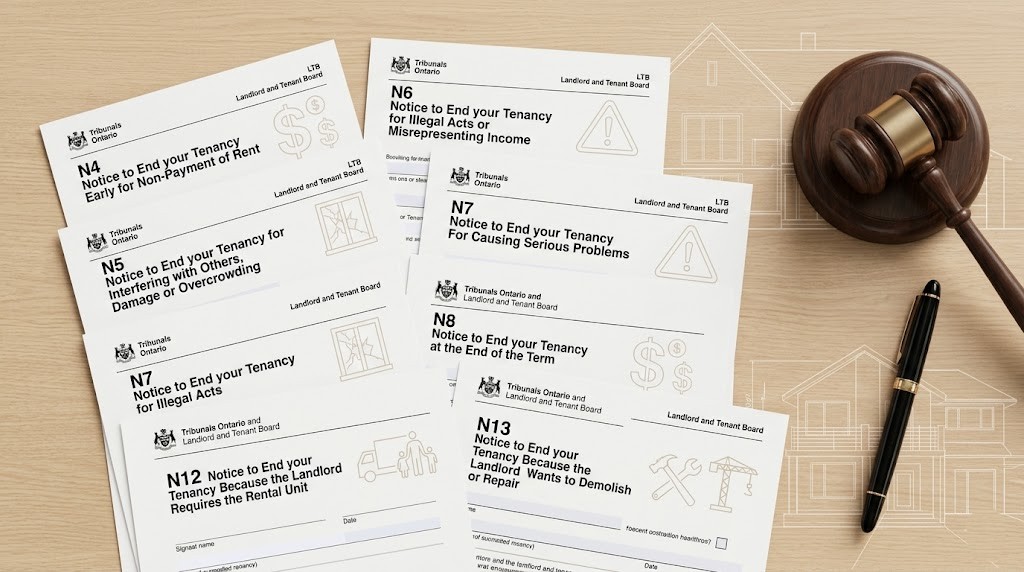
Notice Form: N4 — Notice to End a Tenancy Early for Non-payment of Rent
How it works:
- Tenant must owe at least one cent of rent
- You serve the N4 notice giving the tenant 14 days to pay (for monthly rentals) or 7 days (for daily or weekly rentals)
- If the tenant pays all rent owed within the notice period, the notice is void — you cannot proceed with eviction
- If the tenant does not pay, you file an L1 Application with the LTB
Important: The N4 must state the exact amount owed and the date by which payment must be made. An incorrect amount voids the notice.
Category 2 — Persistently Late Rent
Even if a tenant always eventually pays, Ontario law allows eviction for persistently paying rent late — a pattern of chronic lateness.
Notice Form: N8 — Notice to Terminate at End of Term
- Requires documented evidence of a pattern — typically 3 or more months of late payments
- Gives 60 days notice (or until end of fixed term)
- Tenant cannot void this notice by paying on time after receiving it
Category 3 — Damaging the Property
If a tenant, their guests, or another occupant wilfully or negligently damages the rental unit or the property, you have grounds for eviction.
Notice Form: N5 — Notice to End Tenancy for Interfering with Others, Damage or Overcrowding
- First N5: Gives the tenant 7 days to stop the behaviour or repair/pay for the damage
- If the tenant corrects the issue within 7 days, the notice is void
Second N5 (within 6 months of first): Does not give a remedy period — you can immediately file an L2 Application
Category 4 — Impairment of Safety
If the tenant, their guests, or another occupant is engaging in illegal activity or behaviour that seriously impairs the safety of any person in the building or in the neighbourhood, you can apply for eviction.
Notice Form: N6 — Notice to End Tenancy for Illegal Act or Misrepresenting Income
OR N7 — Notice to End Tenancy for Causing Serious Problems in the Rental Unit or Residential Complex
- The N7 is for serious impairment of safety — 10 days notice, no opportunity to remedy
- Can be filed as an urgent application if there is an immediate safety risk
Category 5 — Illegal Activity on the Premises
If the tenant or an occupant commits an illegal act in the rental unit or the complex — such as drug dealing, assault, or running an illegal business — you can apply for eviction.
Notice Form: N6 — Notice to End Tenancy for Illegal Act
- 10 days notice
- No opportunity for the tenant to remedy the situation
- Evidence is critical — police reports, documented incidents, photographs
Category 6 — Too Many Occupants (Overcrowding)
If the number of people living in the unit violates a health, safety, or housing standard — overcrowding — you can serve an N5 notice.
Category 7 — Landlord's Own Use (Owner Move-In)
If you, your spouse, your child, your parent, or a person who provides care services to you or a family member genuinely needs to move into the unit, you can apply to terminate the tenancy.
Notice Form: N12 — Notice to End the Tenancy Because the Landlord, a Purchaser or a Family Member Requires the Unit
- Requires 60 days notice, ending on the last day of a rental period
- You must pay the tenant one month’s compensation OR offer them another comparable unit
- Critical: You must genuinely intend to use the unit for the stated purpose. If you serve an N12 and then rent to someone else within 12 months, the evicted tenant can apply for compensation of up to 12 months rent
Category 8 — Purchaser's Own Use (Sale of Property)
If you sell your property and the purchaser (or their immediate family) genuinely needs to occupy it, you can serve an N12 on behalf of the purchaser.
- Same requirements as landlord’s own use
- 60 days notice
- One month’s compensation required
- The Agreement of Purchase and Sale must include a clause confirming the purchaser requires vacant possession
Category 9 — Demolition, Conversion, or Major Repairs
If you need to demolish the unit, convert it to a non-residential use, or conduct major repairs that require the unit to be vacant, you can terminate the tenancy.
Notice Form: N13 — Notice to End the Tenancy Because the Landlord Wants to Demolish the Rental Unit, Convert it to Another Use, or Do Major Repairs or Renovations
- 120 days notice
- Tenant has the right to move back in after renovations at the same rent
- Compensation requirements apply
Ontario LTB Eviction Notice Summary
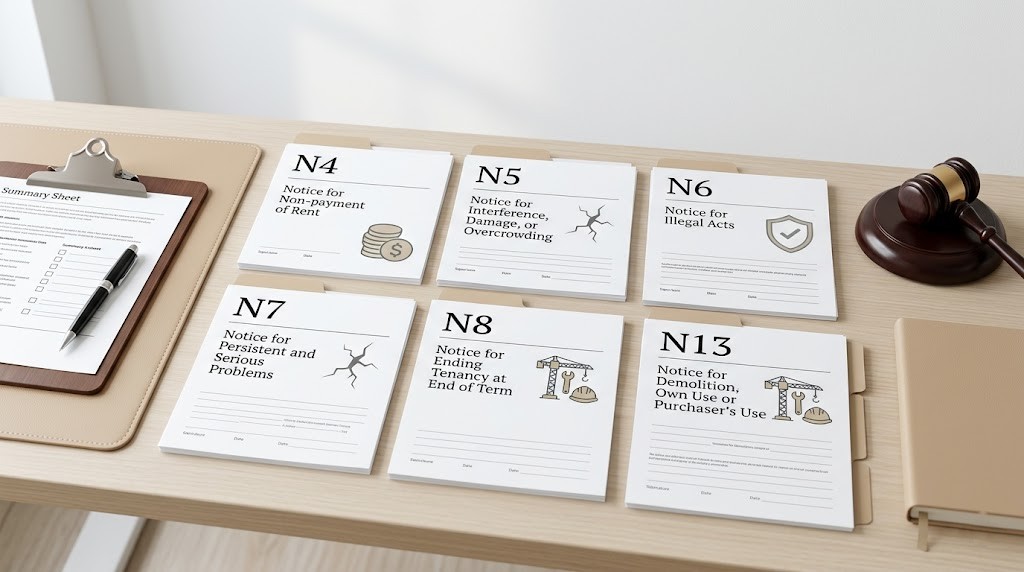
| Reason | Notice Form | Notice Period | Tenant Can Void? |
|---|---|---|---|
| Non-payment of rent | N4 | 14 days (monthly) | Yes — by paying in full |
| Persistently late rent | N8 | 60 days | No |
| Property damage (first) | N5 | 7 days to remedy | Yes — if corrected |
| Property damage (second within 6 months) | N5 | None | No |
| Illegal activity | N6 | 10 days | No |
| Serious safety impairment | N7 | 10 days | No |
| Landlord’s own use | N12 | 60 days | No |
| Major renovation / demolition | N13 | 120 days | No |
What Happens If the Tenant Does Not Leave After the Notice Period?
This is where many landlords make their biggest mistake: you cannot remove the tenant yourself. If the tenant does not vacate by the end of the notice period, your next step is to file an application with the LTB.
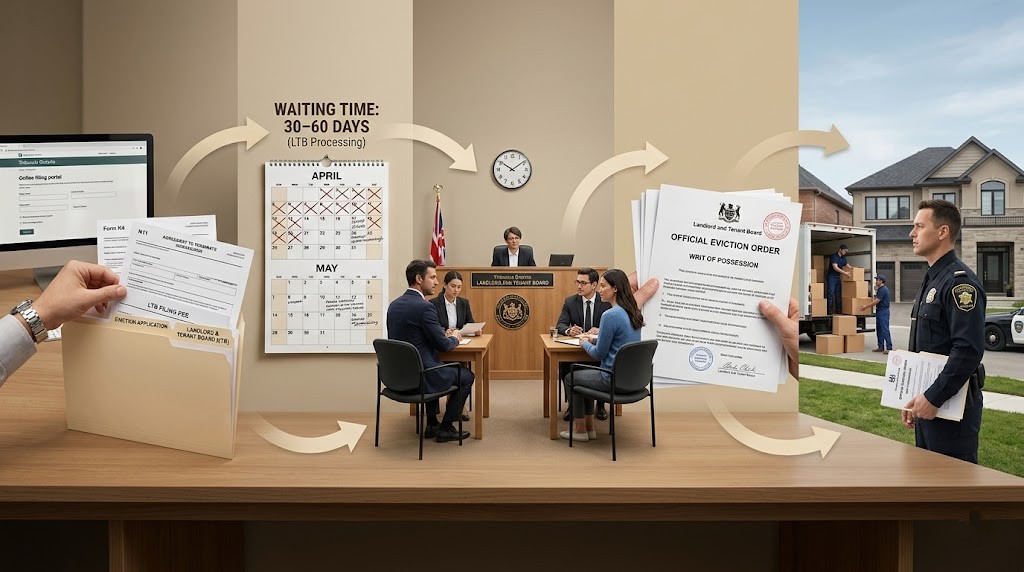
Step 1 — File an LTB Application
- L1 Application: Eviction for non-payment of rent (also claims unpaid rent)
- L2 Application: Eviction for reasons other than non-payment (N5, N6, N7, N8, N12, N13)
- Filing fee applies — currently $186 for an L1, $186 for an L2
File online at ontario.ca/LTB or in person at an LTB office.
Step 2 — Receive a Hearing Date
The LTB schedules a hearing and notifies both parties. In 2026, LTB wait times in Ontario range from 4 to 12 weeks depending on the application type and region — a significant delay that many landlords are not prepared for.
Step 3 — Attend the Hearing
Both you and the tenant have the opportunity to present your case. Prepare thoroughly:
- Bring all documentation — lease agreement, payment records, notices served, photographs, communication logs
- Consider hiring a licensed paralegal to represent you — it significantly improves your outcome
- The adjudicator may grant the eviction, deny it, or grant a conditional order
Step 4 — Receive the LTB Order
If the LTB rules in your favour, you receive an eviction order specifying the date by which the tenant must vacate.
Step 5 — Enforce Through the Sheriff
If the tenant does not comply with the LTB order, you cannot remove them yourself. You must file the order with the Court Enforcement Office (Sheriff) and pay the enforcement fee. The Sheriff will attend the property and enforce the order on a scheduled date.
How Long Does the Ontario Eviction Process Take?
This is the question every landlord asks — and the answer is rarely short.

| Stage | Approximate Time |
|---|---|
| Serving the notice | Day 1 |
| Notice period (N4 non-payment) | 14 days |
| Filing LTB application | Day 15 |
| LTB hearing scheduled | 4 – 12 weeks after filing |
| LTB order issued | Same day or 1–2 weeks after hearing |
| Sheriff enforcement (if needed) | 1 – 3 weeks after order |
| Total (non-payment, uncontested) | 8 – 20 weeks |
| Total (complex contested case) | 4 – 12 months |
For non-payment of rent with a cooperative tenant, the process can move relatively quickly. For contested cases involving own-use applications or disputes over notice validity, expect a significantly longer timeline.
What Are Tenant Rights During the Eviction Process?
Understanding tenant rights is not just for tenants — landlords need to understand them too, to avoid procedural mistakes that can invalidate an eviction.
- Right to remain in the unit until an LTB order is enforced by the Sheriff
- Right to dispute any eviction notice at the LTB
- Right to void the notice where the law permits (N4 non-payment, first N5)
- Right to a hearing before any order is made
- Right to seek review of an LTB order they believe was wrongful
- Protection from illegal eviction — any lockout, utility cutoff, or harassment gives the tenant grounds to apply against you
Common Mistakes Ontario Landlords Make During the Eviction Process
1. Serving the Wrong Notice Form
Every eviction reason has a specific notice form. Serving an N5 for non-payment instead of an N4, or vice versa, can cause your application to be dismissed at the hearing.
2. Incorrect Amounts on the N4
The N4 must state the exact amount of rent owed. Including NSF fees, utilities, or other charges in the N4 amount — unless they are explicitly part of the rent — can void the notice.
3. Not Serving Notice Correctly
Ontario has specific rules for how notices must be served — in person, by mail (with 5 extra days added), by email (if agreed to in writing), or by posting to the door. Incorrect service can invalidate your notice.
4. Accepting Rent Serving a Notice
Accepting any rent payment after serving a notice can be interpreted as waiving the notice. This is particularly common with N12 (own-use) notices — accepting rent after the N12 effectively cancels it.
5. Trying to Remove the Tenant Without an LTB Order
The most dangerous mistake. Changing locks, removing belongings, or cutting utilities before an LTB order and Sheriff enforcement is illegal — regardless of how egregious the tenant’s behaviour has been.
6. Not Documenting Everything
The LTB adjudicator will want evidence. Maintain dated records of all rent payments (and missed payments), all communications, all damage photographs with timestamps, and copies of all notices served with proof of service.
What About the "Bad Faith" Eviction Problem?

Ontario law has specific protections against landlords who use N12 (own-use) or N13 (renovation) notices in bad faith — as a way to remove a tenant so they can re-rent at a higher rate.
If a landlord:
- Serves an N12 and does not actually move in (or move in the stated family member)
- Serves an N13 and does not actually perform the stated renovations
- Re-rents the unit within 12 months at a higher price after an own-use eviction
The former tenant can file an application with the LTB for up to 12 months rent as compensation — plus any costs they incurred from being wrongfully evicted.
This is not theoretical. The LTB has awarded significant compensation in bad faith eviction cases. If you are considering an own-use or renovation eviction, ensure your intention is genuine and well-documented.
Do I Need a Paralegal or Lawyer for an LTB Hearing?

You are not required to have legal representation at an LTB hearing — but it is strongly recommended for anything beyond a straightforward non-payment case.
Consider hiring a paralegal if:
- The tenant is disputing the eviction
- You are serving an N12 or N13 (own-use or renovation)
- The tenant has filed a counter-application against you
- There is a history of disputes or complex facts involved
- The potential rent loss from a failed eviction is significant
Licensed paralegals in Ontario are regulated by the Law Society of Ontario and are authorised to represent landlords at LTB hearings. Their fees are significantly lower than lawyers for tribunal matters.
How HouseForRentInNiagara.com Can Help Niagara Landlords

detailed records, and filing correct paperwork — is stressful, time-consuming, and carries real financial risk if you make a procedural error.
At HouseForRentInNiagara.com, we work with private landlords across Niagara Falls, St. Catharines, Welland, and the broader Niagara Region. We understand the local rental market, the challenges Niagara landlords face, and how to help you manage your rental property more effectively — from finding properly screened tenants in the first place to guiding you through difficult tenancy situations.
If you are currently dealing with a problem tenant, do not navigate it alone.
Frequently Asked Questions — LTB Eviction Rules Ontario
How long does an LTB eviction take in Ontario?
For a non-payment of rent case, expect 8 to 20 weeks from serving the N4 notice to Sheriff enforcement if the tenant does not voluntarily comply. Complex or contested cases — particularly own-use (N12) applications — can take 4 to 12 months. LTB backlogs in 2026 mean hearing wait times of 4 to 12 weeks after filing.
What is the fastest way to evict a tenant in Ontario?
The fastest legal process is for non-payment of rent using the N4/L1 pathway — if the tenant does not pay within 14 days and does not dispute at the LTB, a hearing can be scheduled relatively quickly. For serious safety situations (N7), landlords can request an urgent hearing. There is no legal shortcut around the LTB process.
Can I change the locks to evict a tenant in Ontario?
No. Changing the locks without an LTB order enforced by the Sheriff is an illegal eviction under the Residential Tenancies Act. The tenant can file an immediate application and you could be ordered to pay up to $50,000 in compensation and restore access to the unit immediately.
What notice form do I use for non-payment of rent in Ontario?
Use Form N4 — Notice to End a Tenancy Early for Non-payment of Rent. For monthly tenants, the notice gives 14 days for the tenant to pay. If they pay the full amount owed within 14 days, the notice is void and you cannot proceed with eviction.
Can a tenant void an eviction notice in Ontario?
Yes — for certain notice types. An N4 (non-payment) is voided if the tenant pays all rent owed within the notice period. The first N5 (damage/interference) is voided if the tenant corrects the behaviour within 7 days. Notices like N6 (illegal activity), N7 (safety), N8 (persistent late payment), and N12 (own use) cannot be voided by the tenant.
How much compensation does a landlord owe for an own-use (N12) eviction?
When serving an N12 notice, the landlord must pay the tenant one month’s rent as compensation — or offer a comparable alternative rental unit. If the eviction is later found to be in bad faith, the tenant can claim up to 12 months rent as additional compensation through the LTB.
Can I evict a tenant in Ontario during winter?
Yes — Ontario law does not have seasonal restrictions on eviction. A tenant can be legally evicted at any time of year, including winter, if there is a valid LTB order enforced by the Sheriff.
What happens if a tenant does not leave after the LTB eviction order?
If a tenant does not vacate by the date specified in the LTB order, you must file the order with the Court Enforcement Office (Sheriff) and pay the enforcement fee. The Sheriff will schedule a date to attend the property and enforce the order. You cannot remove the tenant or their belongings yourself.
Can a tenant be evicted for having a pet in Ontario?
Only in limited circumstances. Under Ontario’s RTA, no-pet clauses in leases are void and unenforceable. However, if a pet is causing damage to the property or significant interference with other tenants, you can serve an N5 notice citing the specific damage or disturbance — not simply the presence of a pet.
Should I hire a paralegal for my LTB hearing?
For straightforward non-payment cases, many landlords represent themselves. For disputed evictions, N12 own-use applications, cases where the tenant has filed a counter-application, or any situation with complex facts, hiring a licensed paralegal is strongly recommended. Paralegals are authorised to represent landlords at the LTB and their fees are significantly lower than lawyers for tribunal proceedings.

Arzman Singh
Arzman is a Niagara-based realtor with over 6 years of experience, working with Quantum Team Realty Team. He specializes in helping clients find rental or lease properties, offering expert guidance in the Niagara real estate market.
Published by HouseForRentInNiagara.com | March 2026 | Serving Niagara Falls, St. Catharines, Welland & Niagara Region
Tags: LTB eviction Ontario ontario eviction process 2026 landlord tenant board Ontario N4 notice Ontario N12 eviction Ontario evict tenant Ontario Niagara landlord guide residential tenancies act Ontario houseforrentinniagara ontario rental law