

Blog prepared for HouseForRentInNiagara.com | Niagara Region Rental Listings & Realtor Services | May 2026
The single most consequential decision a Niagara landlord makes is not the rent they charge or the lease they sign — it is who they let through the door.
A bad tenancy in Ontario can mean 4–8 months of lost rent, LTB proceedings, property damage, and thousands of dollars in exposure before a tenant is legally removed. A good tenancy means reliable income, a well-maintained property, and a tenant relationship that works for years.
Tenant screening is how you separate the two. And in Ontario, screening must be done within a precisely defined legal framework — the Ontario Residential Tenancies Act (RTA), the Ontario Human Rights Code, and the guidelines published by the Ontario Human Rights Commission (OHRC).
This guide gives you the complete process: what you can ask, what you cannot ask, what documents to collect, how to evaluate credit and income, how to check references, and how to document your decision to protect yourself against future disputes.
Why Ontario Tenant Screening Is Different

Why Does Ontario Have Strict Rules About Tenant Screening?
Ontario’s Human Rights Code applies to housing — which means it applies to tenant selection. Landlords are prohibited from refusing to rent to — or applying different screening standards to — applicants based on any protected ground under the Code.
This is not optional. It is a legal obligation, and Human Rights Tribunal of Ontario complaints can result in significant financial remedies for applicants who can demonstrate that a protected characteristic was a factor in a landlord’s rejection decision.
The protected grounds in housing under the Ontario Human Rights Code include:
| Protected Ground | What It Means in Tenant Selection |
|---|---|
| Race, ancestry, colour, ethnic origin, place of origin, citizenship | Cannot be a factor in any way. |
| Creed (religion) | Cannot be a factor. |
| Sex, gender identity, gender expression | Cannot be a factor. |
| Sexual orientation | Cannot be a factor. |
| Age | Cannot be a factor. |
| Marital status (including single status) | Cannot be a factor. |
| Family status (including having children) | Cannot be a factor. |
| Disability | Cannot be a factor. |
| Receipt of public assistance | Cannot be a factor in housing. |
Source of income is a critical point for Niagara landlords. Refusing to rent to an applicant because they receive ODSP, Ontario Works, CPP disability, or other government income support is a Human Rights Code violation in Ontario. You can set an income threshold, but it must be applied equally and consider the applicant’s total household income — not exclude applicants based on the type of income they receive.
What Can a Landlord Legally Ask an Ontario Tenant Applicant?

What Questions Can Ontario Landlords Ask When Screening Tenants?
The Ontario Human Rights Commission has published clear guidance on what landlords may and may not ask during the screening process.
What You CAN Ask
- Rental history — previous addresses, names of previous landlords, duration of previous tenancies
- Permission to conduct a credit check — with written consent; you can request Equifax or TransUnion reports
- Name, current address, and date of birth — to conduct an accurate credit check
- Employment and income information — employer name, job title, income, and supporting documentation
- References — previous landlords, professional contacts (with applicant consent)
- Passport or driver’s licence details — for the limited purpose of confirming identity for an accurate credit check only
- Guarantor/co-signer information — you can require a guarantor, but only if you require it of all applicants equally
- Move-in date requirement and occupancy details
- Consent to verify the information provided in the application
What You CANNOT Ask
- Rental history — previous addresses, names of previous landlords, duration of previous tenancies
- Permission to conduct a credit check — with written consent; you can request Equifax or TransUnion reports
- Name, current address, and date of birth — to conduct an accurate credit check
- Employment and income information — employer name, job title, income, and supporting documentation
- References — previous landlords, professional contacts (with applicant consent)
- Passport or driver’s licence details — for the limited purpose of confirming identity for an accurate credit check only
- Guarantor/co-signer information — you can require a guarantor, but only if you require it of all applicants equally
- Move-in date requirement and occupancy details
- Consent to verify the information provided in the application
The Ontario Tenant Screening Process — Step by Step

How Should Ontario Landlords Structure the Tenant Screening Process?
A structured, documented process protects you from Human Rights complaints by demonstrating that all applicants were evaluated against the same objective criteria.
Step 1 — Define Your Tenant Criteria Before Listing
Before accepting a single application, define your minimum tenant criteria in writing. These criteria must be:
- Objective — based on verifiable financial factors, not personal characteristics
- Applied equally — the same threshold applied to every applicant
- Compliant — not based on any protected ground
Example of a permissible written tenant criteria statement:
“We require: (1) verifiable household income that demonstrates the ability to pay the monthly rent; (2) a positive credit history or alternative indicators of financial reliability; (3) a positive rental history from at least one previous landlord; and (4) satisfactory references. These criteria apply to all applicants equally.”
Setting criteria before listing also prevents post-hoc rationalisation — where a landlord unconsciously adjusts their criteria after seeing an application.
Step 2 — Use a Standardised Rental Application Form
| Section | Fields to Include |
|---|---|
| Personal Information | Full legal name, current address, previous address, date of birth (for credit check purposes only). |
| Occupancy | Names of all persons who will occupy the rental unit. |
| Rental History | Current landlord name and contact information, previous landlord name and contact information, duration at each address, and reason for leaving. |
| Employment | Employer name, employer contact details, position, employment start date, and employment type (full-time, part-time, self-employed, or retired). |
| Income | Monthly gross income and all sources of household income. |
| References | At least two references, preferably non-family members. |
| Consent | Written consent to contact references, conduct a credit check, and verify employment information. |
| Declaration | Applicant signature confirming that all information provided is accurate and complete. |
Do not accept incomplete applications. An application without a signature, without rental history, or without income information cannot be properly assessed. Request completion before proceeding.
Step 3 — Run a Credit Check (With Consent)
A credit check is one of the most reliable indicators of a prospective tenant’s payment habits. In Ontario, you must have written consent from the applicant before running a credit check — this is a legal requirement, not optional. Including a consent clause in your standard application form satisfies this requirement.
Credit check services available to Ontario landlords:
- Equifax Canada — offers landlord tenant screening tools
- TransUnion — similar landlord-facing screening options
- Landlord-specific services (e.g., SingleKey, FrontLobby, Certn) — offer bundled credit and background reports with built-in consent management
What to look for in a credit report:
| Positive Indicators | Caution Indicators |
|---|---|
| Score 650+ (good to excellent) | Score below 550 |
| Consistent payment history | Multiple missed or late payments |
| Low credit utilisation | Significant debt load relative to income |
| No recent collections or judgements | Collections, charge-offs, or civil judgements |
| Stable credit history length | Very short or thin credit file (not negative, but warrants additional verification) |
Important: A low or thin credit score alone is not grounds for rejection if the applicant provides alternative evidence of financial reliability — consistent employment, strong landlord references, or a guarantor. The OHRC requires holistic evaluation.
You may accept a credit report provided directly by the applicant from Equifax or TransUnion (a “soft pull” self-check), particularly if the applicant is concerned about the impact of a hard inquiry on their score.
Step 4 — Verify Income and Employment
Income verification is your confirmation that the applicant has the financial capacity to pay rent reliably. Ask for:
- Employed applicants: Recent pay stubs (2–3 most recent), employment confirmation letter on company letterhead, or a signed letter from the employer confirming position, start date, and income
- Self-employed applicants: Most recent 1–2 years’ Notice of Assessment (NOA) from CRA, plus 3–6 months of bank statements
- Retired applicants: Pension statement, CPP/OAS statement, or investment income documentation
- ODSP / OW / Government assistance: Benefits statement confirming monthly amount. Note: You may not treat this income source differently from employment income.
- Combined household income: Where multiple adults will occupy the unit, you may consider combined household income
The 30% rent-to-income rule: The OHRC has explicitly stated that landlords cannot use a strict 30% rent-to-income ratio (requiring that rent be no more than 30% of income) as an automatic disqualifying threshold. You may consider whether an applicant has sufficient income to pay rent, but must consider all available income and financial information together — not apply a blanket mathematical cutoff.
Step 5 — Contact Previous Landlords and Verify Rental History
This step is underutilised by many private Niagara landlords and often the most revealing part of the screening process. A previous landlord has direct experience with the applicant as a tenant and can provide information that no credit report or document can.
Questions to ask a previous landlord:
- Did the tenant pay rent on time and in full?
- Were there any incidents of non-payment, NSF cheques, or payment disputes?
- Was the property maintained in good condition during the tenancy?
- Were there any complaints from neighbours or other tenants?
- Were there any LTB applications filed relating to this tenancy?
- Did the tenant provide proper notice when vacating?
- Would you rent to this tenant again?
How to verify you are speaking to the actual landlord:
- Cross-reference the landlord contact information on the application with what you can independently confirm (address records, land registry, property management listings)
- Ask the applicant on the application form to provide the landlord’s name and contact number — then look up the property address independently to verify it matches
Watch for: Applicants who cannot provide landlord contact information (claiming they always owned), who only provide email addresses and not phone numbers, or whose landlord references are other tenants at the same property.
Step 6 — Contact Employment References
Call the employer contact provided to confirm:
- The applicant is currently employed there
- Their stated position and employment type are accurate
- Their tenure is as stated
This is a quick verification call — you are not asking for an employment reference in the personal sense, simply confirming that the information provided is accurate.
Step 7 — Document Your Decision
When you select a tenant, document why you selected them, based on the objective criteria you defined in Step 1. When you decline an applicant, document why based on the same objective criteria.
A clear documentation trail is your primary protection in the event of a Human Rights complaint from a declined applicant. Your documentation demonstrates:
- The same criteria were applied to all applicants
- The selected applicant met those criteria more strongly on the relevant financial and rental history factors
- No protected characteristic was a factor in the decision
Keep all application forms, reference call notes, credit reports, income documents, and decision records for a minimum of one year after the tenancy begins (or the application is declined).
Red Flags in Tenant Applications — What to Watch For

What Red Flags Should Niagara Landlords Watch for During Screening?
These are warning indicators that warrant additional verification — not automatic disqualifiers. Each must be assessed within the full context of the application and in accordance with the Human Rights Code.
| Red Flag | Why It Matters | Appropriate Response |
|---|---|---|
| Incomplete application | May indicate unwillingness to disclose information. | Request completion before proceeding. |
| Unable to provide previous landlord contact | May be avoiding a negative reference. | Ask for an explanation and attempt independent verification. |
| Credit report shows multiple recent missed payments | Pattern of payment difficulty. | Assess alongside income and references; consider a guarantor. |
| Income cannot be independently verified | May be inflated or fabricated. | Request additional documentation such as NOA or bank statements. |
| Income documents appear inconsistent (font, format changes) | Possible document fraud. | Request original documents or direct employer confirmation. |
| Reference phone numbers go to voicemail only | May be fake references. | Try alternate contact methods and request written references. |
| Very recent employment start date with prior gap | May affect income stability. | Ask for prior employment history or additional income sources. |
| Applicant pressures for quick decision without completing forms | May be trying to shortcut screening. | Maintain your process — no exceptions. |
Building a Compliant Selection Decision

How Do I Choose Between Multiple Qualified Applicants?
When multiple applicants meet your defined criteria, you can select based on objective financial factors — stronger credit history, longer stable employment, more positive landlord references. Document your reasoning.
What you cannot do:
- Select based on any protected characteristic (even positively — e.g., “they seemed like a nice family” is not a documented financial criterion)
- Apply different thresholds to different applicants for undocumented reasons
- Select first-come-first-served without reviewing all applications equally
A simple selection matrix helps. Score each applicant on your objective criteria (credit score band, income adequacy, rental history length, reference quality) using consistent thresholds. The applicant with the strongest objective score is your selection. Document the matrix.
Tenant Screening Checklist — Quick Reference
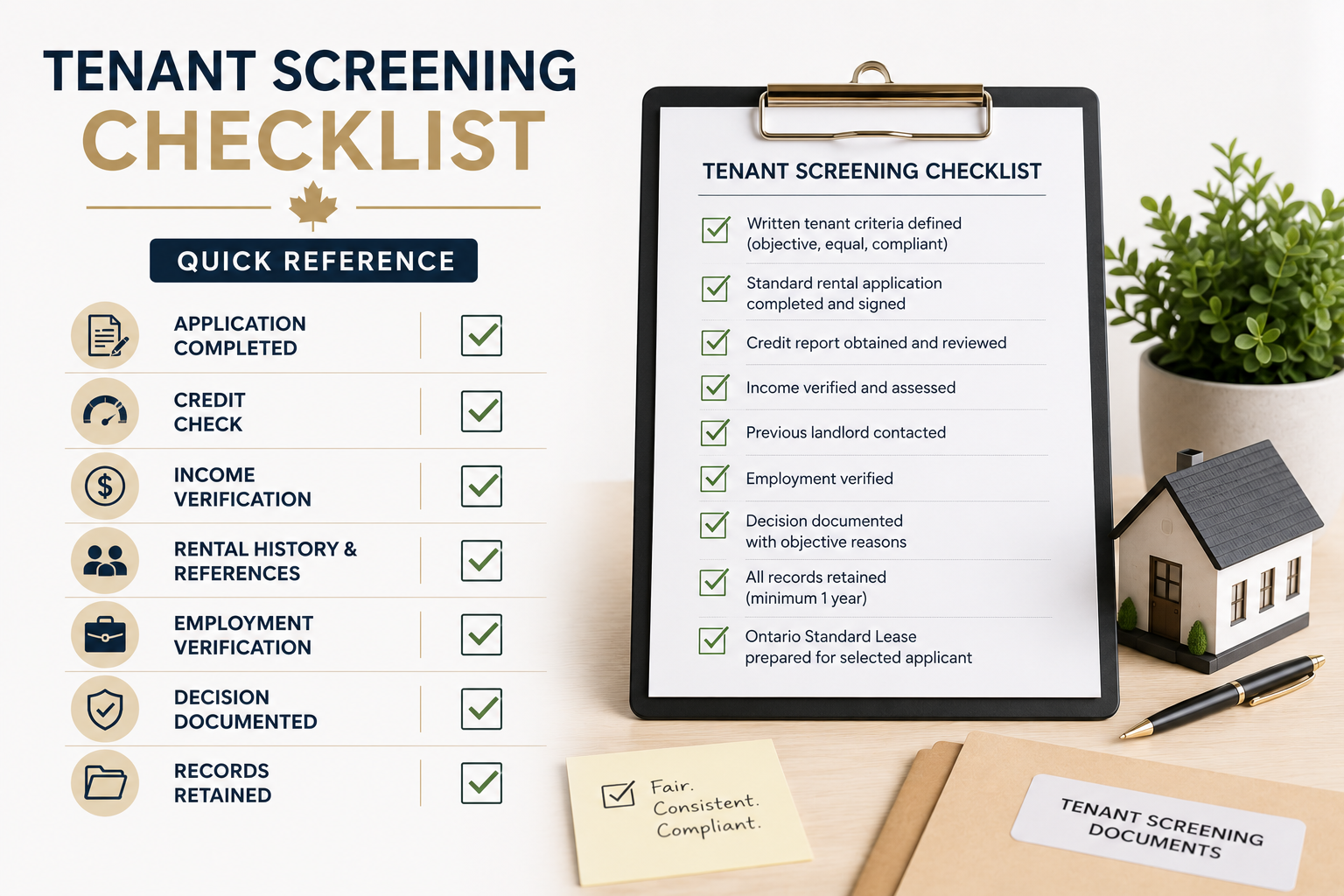
Complete Ontario Tenant Screening Checklist for Niagara Landlords
Before Listing
- Written tenant criteria defined (objective, equal, compliant)
- Standard rental application form prepared (includes consent clauses)
Application Collection
- All applicants complete the same standard form
- All sections completed and signed before processing
Credit Check
- Written consent confirmed on application form
- Credit report obtained from Equifax, TransUnion, or accredited service
- Score and payment history reviewed; thin file noted
Income Verification
- Pay stubs / employment letter (employed)
- NOA + bank statements (self-employed)
- Benefits statement (government income)
- Income assessed for capacity to pay
Rental History Verification
- Previous landlord contact independently verified
- Previous landlord called and notes recorded
- Duration and circumstances of prior tenancies confirmed
Employment Verification
- Employer contact confirmed and called
- Position, tenure, and status confirmed
Decision Documentation
- Selected applicant: objective reasons recorded
- Declined applicants: objective reasons recorded
- All records retained (minimum 1 year)
- Ontario Standard Lease prepared for selected applicant
Want a Realtor to Handle Tenant Screening for Your Niagara Property?
The screening process described in this guide takes time, structure, and legal awareness. A Realtor who specialises in Niagara Region rentals brings all three — plus MLS reach, professional marketing, and documented process that protects you from Human Rights exposure.
At HouseForRentInNiagara.com, our network of Niagara Realtors manages the full tenant lifecycle — from listing and marketing to screening, selection, and lease preparation. We exist to connect Niagara landlords with qualified, compliant tenants — efficiently, legally, and profitably.
📞 Talk to a Niagara rental Realtor at HouseForRentInNiagara.com
📍 Serving St. Catharines, Niagara Falls, Welland, Fort Erie, Grimsby, Thorold, Lincoln, and surrounding areas
Frequently Asked Questions
Can an Ontario landlord reject a tenant application based on credit score alone?
Not automatically. Under the Ontario Human Rights Commission’s guidelines, a landlord must consider all available information holistically — including income, employment, rental history, and references — and cannot rely solely on a credit score to reject an applicant. A low score resulting from specific circumstances (e.g., a past divorce, medical debt, or a period of unemployment) does not automatically disqualify an applicant if other indicators of financial reliability are strong. Similarly, a thin or absent credit file (common for new Canadians and young renters) should not be treated as a negative factor — it requires consideration of other evidence. Rejection based purely on credit score, particularly when the applicant has strong income and rental history, can expose a landlord to a Human Rights complaint if a protected characteristic was also a factor.
Can I ask an Ontario tenant applicant for their Social Insurance Number?
No. You cannot legally require an applicant to provide their Social Insurance Number (SIN) to complete a rental application or run a credit check. Only the applicant’s full legal name, current address, and date of birth are required to pull a credit report from Equifax or TransUnion. An applicant who declines to provide their SIN cannot be rejected on that basis. Requesting a SIN creates unnecessary privacy risk and is not a legally permissible screening requirement in a residential tenancy context.
Can I refuse to rent to someone because they receive ODSP or Ontario Works?
No. Refusing to rent to a prospective tenant because their income comes from ODSP, Ontario Works, CPP disability, or other government assistance is a violation of the Ontario Human Rights Code. Source of income is a protected ground in Ontario housing. You can set an income threshold that applies equally to all applicants — e.g., requiring verifiable income sufficient to pay rent — but you cannot exclude applicants whose income comes from public assistance programs. If a prospective tenant’s total ODSP or OW income meets your threshold, they cannot be declined on the basis of where that income comes from.
Do I have to consider an applicant who has no previous rental history?
Yes — a lack of rental history should not automatically disqualify an applicant. Many first-time renters (young adults, new Canadians, people transitioning from homeownership) will have no rental history. In these cases, you should consider alternative indicators: employment stability, income adequacy, personal or professional references, and potentially a guarantor or co-signer. Treating no rental history as a disqualifying factor can disproportionately affect protected groups (e.g., newcomers, younger applicants) and may create Human Rights exposure.
Can I use a strict 30% rent-to-income ratio to screen Ontario tenants?
No. The Ontario Human Rights Commission has specifically stated that applying a strict rent-to-income ratio (such as the common “rent should be no more than 30% of income” rule) as an automatic disqualifier is not a permissible screening practice. You may assess whether an applicant has sufficient income to pay the rent, but you must consider all available information — income level, income stability, credit history, rental history — rather than applying a blanket mathematical threshold that automatically excludes applicants. Using the 30% rule as a hard cutoff can disproportionately exclude low-income applicants and create Human Rights exposure.
How do I verify that a previous landlord reference is genuine?
To verify a landlord reference, do not rely solely on the contact information provided by the applicant. Independently verify the property address — check land registry records, Google the address, or confirm through publicly available property listings — and look up the landlord’s name independently. Call the landlord at a number you sourced independently, not just the number provided on the application. During the call, ask specific questions that only a genuine landlord would know: the approximate move-in date, the monthly rent amount, whether there was a pet, what notice was given. Genuine landlords can answer these questions. Fake references typically cannot.
Should I require a guarantor for all applicants with lower credit scores?
A guarantor can be a reasonable risk mitigation tool for applicants who have otherwise strong rental and employment profiles but a weaker or thin credit history. Under the Ontario Human Rights Commission’s guidelines, you can require a guarantor — but only if you require it consistently for all applicants who fall below a defined, objective threshold (e.g., credit score below a stated band, or income below a stated level). You cannot require a guarantor selectively from specific applicants in a way that discriminates based on a protected ground. If you require a guarantor in a consistent, documented, objective way, it is a permissible screening tool.
How long should I keep tenant screening records in Ontario?
Retain all screening records — application forms, credit reports, income documents, reference call notes, and decision documentation — for a minimum of one year after the decision is made (whether the applicant was selected or declined). In the event of a Human Rights Tribunal complaint, which must generally be filed within one year of the alleged discrimination, you will need this documentation to demonstrate that your selection process was compliant and objective. Some landlords retain records for two years to provide additional margin.
What is the most common tenant screening mistake Niagara landlords make?
The single most common mistake is relying on informal judgment rather than a documented, structured process. This includes skipping the previous landlord call (because the application looked fine), not getting written consent before running a credit check, accepting incomplete applications under pressure, or making a selection decision based on an intangible sense of the applicant’s character rather than documented, objective criteria. Each of these shortcuts either creates legal exposure (Human Rights complaint, privacy law violation) or misses information that a structured process would have caught. The second most common mistake is failing to document the decision — which means that even if the decision was correct and compliant, the landlord has no evidence to defend it.

Arzman Singh
Arzman is a Niagara-based realtor with over 6 years of experience, working with Quantum Team Realty Team. He specializes in helping clients find rental or lease properties, offering expert guidance in the Niagara real estate market.
Disclaimer: This blog provides general legal information and is not legal advice. Consult a licensed paralegal or lawyer for advice specific to your situation.