
Rent-to-Own Homes in Niagara: Is It Right for You?
Owning a home in Niagara is a goal for thousands of renters across the region — but for many, the traditional path to homeownership feels blocked. The down payment is not saved yet. The credit score is not quite where a lender needs it to be. A recent job change or self-employment income makes mortgage qualification complicated. The timing simply is not right for a conventional purchase.
Rent-to-own is one of the most talked-about alternatives for people in exactly that position. It offers a way to move into a home today, build toward a purchase over a set term, and lock in a price while the market moves. But it is not the right fit for everyone, and the details of the agreement matter enormously.
This guide explains how rent-to-own homes in Niagara work, who they are designed for, what the risks are, and how to decide whether it is the right step for your situation in 2026.
Who Is This Guide For?
- Renters currently living in Niagara Region who want to own a home but cannot yet qualify for a mortgage.
- First-time buyers who need time to save their down payment while living in their target home.
- Newcomers to Canada building credit history and employment records before applying to a lender.
- Self-employed individuals whose income documentation makes conventional mortgage qualification difficult.
- Anyone who has been declined for a mortgage and wants to understand their next realistic step toward ownership.
If you are currently renting in Niagara and homeownership is your goal, this guide will help you understand rent-to-own clearly — so you can make an informed decision rather than an emotional one.
What Is a Rent-to-Own Home?
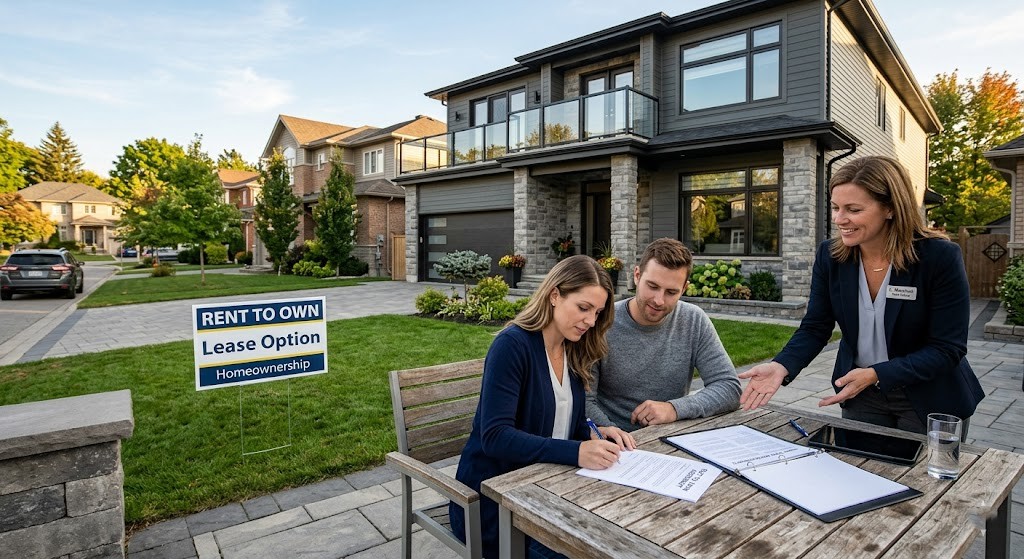
A rent-to-own agreement — also called a lease-to-own or lease-option agreement — is a contract that lets you rent a property today with the option (and sometimes the obligation) to purchase it at a pre-agreed price at the end of the rental term. In Canada, rent-to-own agreements typically run for one to three years.
The key feature that makes rent-to-own different from a regular tenancy is that a portion of your monthly rent payment is credited toward your future down payment — so you are building equity while you live in the home, even before you own it.
In Ontario specifically, rent-to-own arrangements legally require two separate agreements:
- A lease agreement — covering monthly rent, term length, included services, and your rights as a tenant under Ontario law.
- An option-to-purchase agreement — which specifies the agreed purchase price, the amount of rent credited toward the down payment, and the conditions under which you can exercise (or walk away from) the purchase option.
Both documents must be in place for the arrangement to be legally valid in Ontario. Any rent-to-own offer that combines these into a single informal document should be reviewed by a real estate lawyer before signing.
| Stage | What Happens | What You Should Know |
|---|---|---|
| Agreement signed | Purchase price locked in. Lease term begins (typically 1–3 years). | Price is fixed now — you benefit if market rises; you may overpay if it falls. |
| Option deposit paid | Upfront amount paid to secure the option to buy (typically 1–5% of purchase price). | This is usually non-refundable if you choose not to purchase. |
| Monthly rent paid | Rent paid each month. A portion is credited toward future down payment. | The credit portion is typically $300–$700/month depending on the program. |
| Credit building period | You use the term to improve credit score, save, and prepare for mortgage approval. | This is the core purpose — use this time actively, not passively. |
| End of term | You exercise your option to purchase at the agreed price using accumulated credits + savings. | If you cannot qualify for a mortgage at end of term, you may forfeit credits. |
What Does the Niagara Housing Market Look Like in 2026?

Understanding the current market helps you evaluate whether locking in a rent-to-own price today makes strategic sense.
| Market Indicator | Niagara 2026 Data | What It Means for Rent-to-Own Buyers |
|---|---|---|
| Benchmark home price | $573,900 (down 8.3% year-over-year, Jan 2026) | Prices are softer — a locked-in rent-to-own price may be reasonable. |
| Days on market | 67 days average | Sellers are more negotiable — rent-to-own terms may be more flexible. |
| Market absorption rate | ~11% of listings sold | Buyer-leaning market — more inventory gives you more choice. |
| Rental range (2-bed apt) | $1,600–$2,200/month | Rent-to-own monthly payments typically sit in a comparable or slightly higher range. |
| Interest rate outlook | Bank of Canada holding near 2.75% | Stable rates help you plan mortgage qualification at end of term. |
| Entry-level home price | ~$480,000+ in south Niagara | Rent-to-own opens access to ownership without immediate full down payment. |
The current Niagara market — with softer prices, longer days on market, and a buyer-leaning balance of supply — is one where rent-to-own terms can be negotiated more favourably than in a hot market. Sellers who have struggled to sell may be open to rent-to-own as a path to securing a committed buyer.

- You move into the home you plan to own — not a temporary place while you save elsewhere.
- The purchase price is locked in at today’s value — protecting you from future price increases during your term.
- A portion of each monthly payment builds toward your down payment automatically.
- You have time to improve your credit score, organise your income documentation, and prepare a stronger mortgage application.
- You get to experience the home and neighbourhood before committing to the full purchase.
- In a slower market like Niagara in 2026, sellers may be willing to negotiate favourable option terms.

- Option deposits are typically non-refundable — if you choose not to purchase or cannot qualify at the end of the term, you lose that money.
- Monthly payments are usually higher than equivalent market rent, because the extra amount is going toward your down payment credit.
- If property values fall during your term, you could end up purchasing at a price above market value.
- If you cannot secure mortgage financing at the end of the term, you may forfeit all accumulated rent credits.
- Not all rent-to-own programs are equal — some are structured more favourably for the seller than the buyer.
- Maintenance responsibilities can sometimes be partially transferred to the tenant in rent-to-own agreements — clarify this before signing.
The most important risk management step is legal review. Before signing any rent-to-own agreement in Ontario — including both the lease and the option-to-purchase — have a real estate lawyer review both documents independently.
| Factor | Rent-to-Own | Conventional Renting | Buying Now |
|---|---|---|---|
| Down payment required now | Low (option deposit only) | None | 5–20%+ of purchase price |
| Equity building | Yes (partial, via rent credits) | No | Yes (full mortgage payments) |
| Price certainty | Yes (locked in at signing) | N/A | Market price at time of purchase |
| Flexibility to walk away | Yes (forfeit deposit/credits) | High | Low (selling costs significant) |
| Credit score requirement | Lower (time to improve during term) | Minimal | 620–680+ typically required |
| Mortgage needed | At end of term | No | At start |
| Monthly cost | Higher than market rent | Market rate | Mortgage + taxes + maintenance |
How Do You Know If Rent-to-Own Is Right for You?

Rent-to-own is most likely the right path if all of the following are true:
- You have a clear timeline to mortgage qualification — credit improvement, income stabilisation, or savings accumulation — that makes the 1–3 year rent-to-own term realistic.
- You have identified a home and neighbourhood in Niagara where you genuinely want to live long-term.
- You have or can save the option deposit (typically 1–5% of the purchase price).
- You understand and accept that the option deposit is non-refundable if you do not proceed.
- You have reviewed both agreements with a real estate lawyer and understand your obligations.
- You have a concrete plan for the credit building or savings work that needs to happen during the term.
If you are uncertain about your mortgage qualification timeline, or if your financial situation is volatile, rent-to-own can become an expensive detour. Speaking with a mortgage broker before entering a rent-to-own agreement is strongly recommended — so you know exactly what you need to achieve and whether the term is realistic.
Where Do You Start Looking for Rent-to-Own Homes in Niagara?
- Rental listing platforms: Some owners list rent-to-own opportunities on sites like Kijiji. Search specifically for “rent to own” in Niagara Falls, St. Catharines, Welland, and Fort Erie.
- Rent-to-own program providers: Companies like JAAG Properties, Mirabella Homes, and Requity Homes operate structured rent-to-own programs in Ontario, including the Niagara Region.
- Real estate agents: Agents familiar with the Niagara market can sometimes identify sellers willing to consider rent-to-own arrangements, particularly in the current slower market.
- Mortgage brokers: A mortgage broker can assess your qualification timeline and recommend whether rent-to-own makes sense given your specific financial profile.
Looking for Rental and Rent-to-Own Options in Niagara?
Whether you are ready to rent-to-own or still exploring your options in the Niagara Region, houseforrentinniagara.com is your local resource for finding available rental homes across St. Catharines, Niagara Falls, Welland, Fort Erie, and surrounding communities.
Browse Available Rentals in Niagara → https://houseforrentinniagara.com/
Contact Us → https://houseforrentinniagara.com/contact/
- Browse Homes for Rent in Niagara → https://houseforrentinniagara.com/
- Rental Listings in St. Catharines → https://houseforrentinniagara.com/st-catharines/
- Rental Listings in Niagara Falls → https://houseforrentinniagara.com/niagara-falls/
- Rental Listings in Welland → https://houseforrentinniagara.com/welland/
- Contact Us → https://houseforrentinniagara.com/contact/
Frequently Asked Questions
What is a rent-to-own home in Niagara?
A rent-to-own home in Niagara is a property you rent today with a legal option to purchase it at a pre-agreed price at the end of the rental term — typically one to three years. A portion of your monthly rent is credited toward your future down payment.
How does rent-to-own work in Ontario?
In Ontario, rent-to-own requires two separate legal agreements: a lease agreement covering your tenancy terms under Ontario law, and an option-to-purchase agreement specifying the purchase price, down payment credits, and your right to buy at the end of the term. Both must be in writing.
Is the option deposit refundable in a rent-to-own deal?
In most cases, the option deposit is non-refundable. If you choose not to purchase the home at the end of the term — or cannot qualify for a mortgage — you typically lose the deposit and any accumulated rent credits. This is one of the most important risks to understand before signing.
How much of my rent goes toward the down payment in a rent-to-own program?
The amount varies by program and agreement. In most Niagara rent-to-own arrangements, between $300 and $700 per month is credited toward the purchase. Over a three-year term, this could accumulate to $10,800–$25,200 toward your down payment.
What happens if I cannot get a mortgage at the end of the rent-to-own term?
If you cannot secure mortgage financing at the end of the term, you will not be able to purchase the property. Depending on your agreement, you may forfeit the option deposit and all accumulated rent credits. This is why working with a mortgage broker during the term — not just at the end — is essential.
Is rent-to-own a good idea in the Niagara housing market in 2026?
In 2026, Niagara’s buyer-leaning market with a benchmark price of $573,900 and longer days on market means sellers may be more open to rent-to-own arrangements. Locking in a price now could be advantageous if prices recover during your term — but if prices fall further, you could be buying above market. Legal and financial advice before signing is essential.
Can newcomers to Canada use rent-to-own to buy a home in Niagara?
Yes. Rent-to-own is commonly used by newcomers who need time to establish Canadian credit history and employment records before qualifying for a conventional mortgage. The 1–3 year term provides the runway to build the profile lenders require.
Do I need a real estate lawyer for a rent-to-own agreement in Ontario?
Yes — strongly recommended. Ontario rent-to-own agreements involve significant financial commitments and non-refundable deposits. A real estate lawyer can review both the lease and the option-to-purchase agreement to ensure your rights are protected and the terms are fair before you sign.
How is rent-to-own different from just renting a house in Niagara?
Standard renting provides flexible housing with no path to ownership. Rent-to-own includes a legal option to purchase the property at a fixed price, with monthly credits building toward your down payment. The trade-off is higher monthly payments and non-refundable deposits — in exchange for a structured path toward owning the home you are living in.

Arzman Singh
Arzman is a Niagara-based realtor with over 6 years of experience, working with Quantum Team Realty Team. He specializes in helping clients find rental or lease properties, offering expert guidance in the Niagara real estate market.